


Anahita Khodadadi
Degree Programs: Ph.D. Arch ’19
Current Employer: University at Buffalo
Job title: Assistant Professor
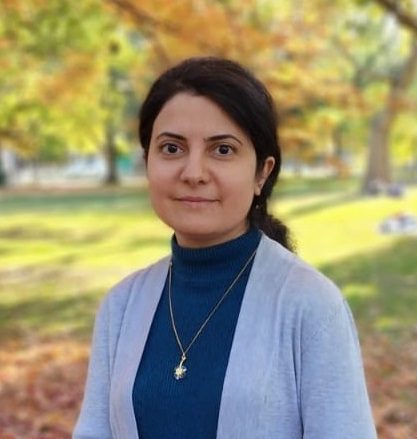
Ph.D. in Architecture
“I was looking for a doctoral program where architectural design could be investigated through rigorous computational inquiry without losing its creative dimension.”
Describe the work you do. What are some of your recent and current projects that excite you? What inspires you about the future of your chosen field?
I am an Assistant Professor of Architecture at the University at Buffalo, where my research and teaching explore how computational and AI-enabled methodologies can help architects make more informed, responsible, and impactful design decisions. My work brings together computational design, building science, learning sciences, and sustainability around an idea I describe as design intelligence: the ability to integrate creativity, technical knowledge, environmental responsibility, and emerging technologies when addressing complex design challenges.
One area of my research develops designer-centered computational methodologies for early-stage design exploration and multi-objective decision-making. I am interested in computational systems that help architects explore alternatives, understand trade-offs, and incorporate both quantitative performance criteria and qualitative design intentions while maintaining human agency in the design process.
More recently, I have expanded this research into artificial intelligence. I am investigating how AI can make computational design methods more accessible and intuitive while preserving architects’ creative and critical roles. In parallel, I study how architecture students learn to engage with AI and other emerging technologies. My current educational research examines how generative AI influences design thinking, critical reflection, computational literacy, and student autonomy, and how architectural education can prepare students to engage with these technologies critically, effectively, and responsibly.
What excites me most about the future of architecture is the convergence of these areas. As computational and AI technologies become increasingly capable, I believe the most important question is not how much of architectural design can be automated, but how we can use these technologies to expand human creativity, strengthen critical judgment, and make more environmentally and socially responsible design decisions.
Why did you choose Taubman College for your education?
I came to Taubman College with a strong interest in the relationship between geometry, structural behavior, and computational design, as well as a clear aspiration to pursue an academic career. I was looking for a doctoral program where architectural design could be investigated through rigorous computational inquiry without losing its creative dimension.
Taubman College was my first choice because my interests closely aligned with Professor Peter von Bülow’s research in computational design, structural systems, and evolutionary design methods. The opportunity to work with him and engage with the research environment he had established was particularly important to me. At the same time, the breadth of the University of Michigan offered opportunities to learn beyond architecture, such as studying in the Computer Science Department or the School of Education. This helped me develop the interdisciplinary approach that continues to characterize my work today.
How did Taubman College prepare you for your career? What experiences beyond the classroom (internships, research assistantships, teaching opportunities, or other external experiences) provided additional value?
My doctoral education at Taubman College established the intellectual foundation for much of what I do today. My dissertation investigated computational design exploration and developed a framework integrating Genetic Algorithms with the Theory of Inventive Problem Solving (TRIZ) to support conceptual design exploration and multi-objective decision-making. More importantly, that work taught me to think about computation not simply as a means of automating design, but as a way of helping designers explore possibilities, negotiate competing objectives, and make informed decisions.
That principle continues to shape my research today, even as the technologies and questions have evolved. My current work on human-centered AI, computational literacy, and designer agency can be traced back to questions that emerged during my doctoral research: How should designers interact with computational systems? How can technology expand rather than constrain exploration? And how can designers maintain agency as computational systems become increasingly capable?
My experiences beyond doctoral research were equally influential. Through the University of Michigan’s Center for Research on Learning and Teaching, I participated in programs focused on inclusive teaching and intercultural leadership. I also volunteered with the Michigan Architecture Preparation Program, working with students from Detroit Public Schools. Those experiences broadened my understanding of educational access and helped shape my commitment to making technical architectural knowledge more accessible.
Teaching opportunities at Michigan also helped me discover how much I valued education as a form of inquiry. Today, teaching and research are deeply interconnected in my work. I study how architecture students learn engineering, computation, sustainability, and AI, and I use those findings to continuously refine how I teach these subjects.
How has being part of the alumni community impacted you, personally and professionally?
Being a Taubman College and University of Michigan alumna remains an important part of my academic identity. My years at Michigan shaped not only the subject of my doctoral research but also how I approach scholarship: with curiosity across disciplinary boundaries and a willingness to connect architectural questions with ideas from engineering, computation, education, and other fields.
Professionally, I continue to encounter Michigan and Taubman alumni through academia, conferences, research, and practice. There is a shared intellectual connection that extends beyond graduation, even as our individual careers move in very different directions.
Personally, my connection to Michigan also reflects an important period of growth in my life. I came to Ann Arbor as an international doctoral student and found a diverse academic community that exposed me to different people, ideas, and perspectives. Those experiences continue to influence how I approach collaboration, mentoring, and academic community today.
What did you like best about attending Taubman College?
What I valued most was the intellectual freedom to explore questions that crossed disciplinary boundaries. My interests did not fit neatly within architecture, structural engineering, or computation alone, and Taubman gave me the opportunity to work across those areas rather than forcing them apart.
I also valued being part of the larger University of Michigan community. Resources and programs beyond Taubman College expanded my education in ways I did not anticipate when I began my doctoral studies. Programs in teaching and learning, opportunities for interdisciplinary research, and engagement with students and scholars from different backgrounds all contributed to my development as both a researcher and educator.
Most importantly, I remember Michigan as a community that was supportive during challenging moments. That sense of belonging and support has remained with me long after graduation.
What advice or important lesson would you share with someone considering Taubman College?
Take advantage of the university, not only the program. One of the greatest opportunities at Michigan is access to an extraordinary range of people, disciplines, resources, and ideas. Some of the experiences that most influenced my career occurred outside the immediate boundaries of my doctoral research.
I would also encourage students to pursue questions that genuinely interest them, even when those questions do not fit neatly within an established disciplinary category. My own research began at the intersection of architectural design, structural engineering, and computation. Over time, those questions led me toward learning sciences, sustainability, and artificial intelligence. The technologies have changed considerably, but the underlying questions about design, decision-making, creativity, and human agency have remained remarkably consistent.
Finally, learn technologies deeply, but do not allow technologies to define your intellectual identity. Tools change quickly. The ability to formulate meaningful questions, think critically, evaluate alternatives, collaborate across disciplines, and continue learning will remain valuable throughout your career.
Other thoughts, advice, or knowledge you would like to share?
One lesson I have learned since leaving Michigan is that a research trajectory does not need to follow a straight line. New technologies, collaborations, teaching experiences, and societal challenges can change the questions we ask. What matters is identifying the deeper intellectual commitments that connect those questions.
For me, that connection is design intelligence. My doctoral research investigated how computational methods could help designers explore alternatives and make better decisions. Today, I ask related questions about artificial intelligence, architectural education, and sustainable design: How can emerging technologies expand rather than replace human creativity? How can we prepare future architects to use them critically and responsibly? And how can better design decisions contribute to a more sustainable built environment?
Looking back, Taubman College gave me more than the methodological foundation for my dissertation. It helped me develop the confidence to work between disciplines, to remain curious as technologies and research questions evolve, and to see research, teaching, and professional engagement as interconnected parts of an academic career.
