Mumbai architect Sameep Padora discusses his work, global knowledge sharing, and the legacy of Charles Correa, B.Arch ’53, during Taubman College visit
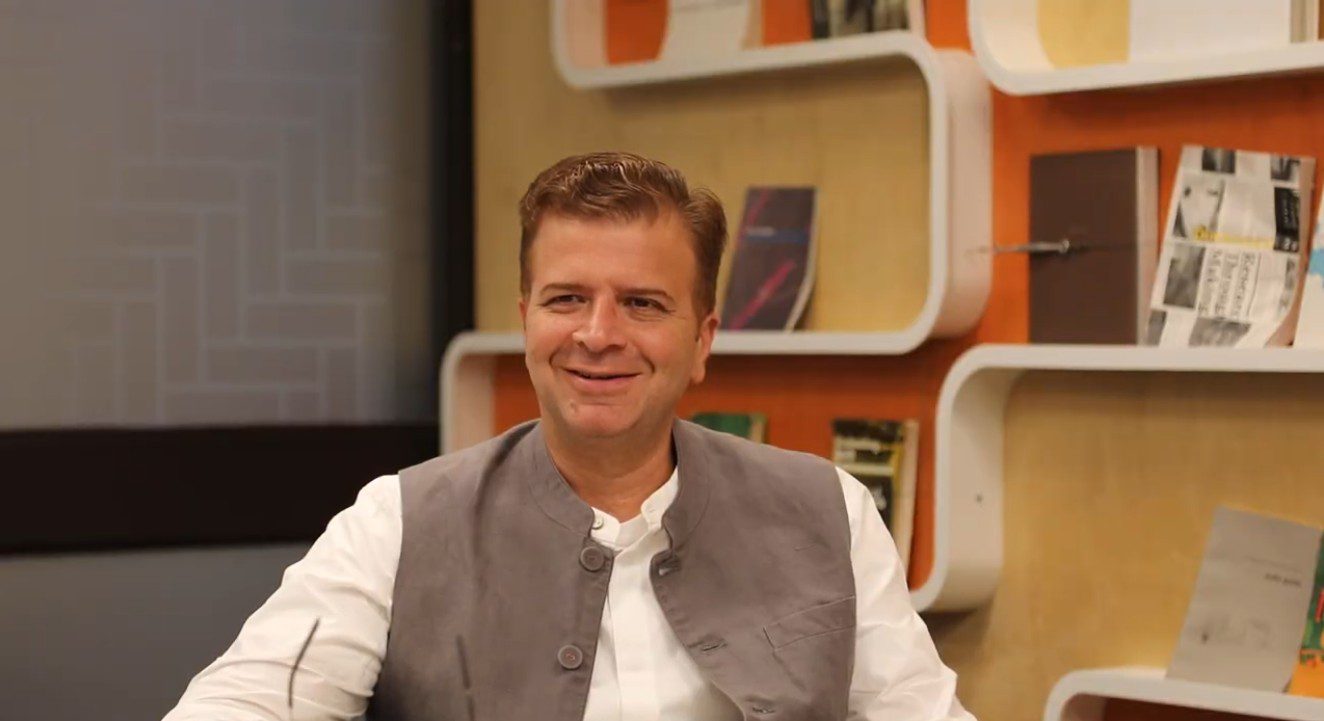
Taubman College hosted Mumbai-based architect Sameep Padora earlier this semester as part of its ongoing Correa Lecture Series. Speaking to a group of students and professors from architecture, urban planning, and urban technology, Padora discussed the motivations behind his work and the challenges of completing projects on a shoe-string budget.
The Charles Correa International Lecture fund was established in 2016 in honor of renowned Indian architect Charles Correa, B.Arch. ’53, and annually hosts an international architect for a lecture on their work. This year, Padora was invited to speak about his firm, sP+a, and nonprofit sPare, which researches urbanization in India.
The Correa Lecture represents a unique opportunity for students to learn from an international perspective. In an interview with the Taubman College Newsroom following his lecture, Padora said Correa’s work is foundational to how he and his peers practice architecture in India.
“There are value propositions in Correa’s work, and in the work of my own practice and of my peers that practice in India today, that build on Correa’s ideas,” Padora said. “These value propositions are relevant not just for our country but for the world at large. They talk about frugality, sensitivity to material and process, and to an understanding of culture and lived experiences in a way that is, in some sense, unique to the Indian condition but also an integral part of Correa’s work.”
Padora’s talk focused on a number of his projects, including a library, student hostels, and temples. At the center of all of these projects is a combination of inspiration from India’s architectural history, modern techniques, and local materials. His project, the Maya Somaiya Library, blends Swiss and Uruguayan building technologies with Spanish techniques and local materials from Maharashtra.
“It’s been like this in the past, there are durable knowledge networks that traditionally used to perpetuate throughout the world through trade routes,” Padora said. “But today, because of our interconnectedness, these knowledge networks are even more accessible and embedded in our day-to-day work. I think there’s an incredible amount for us to take away from these knowledge networks, to deepen what local value systems are. I don’t see these as contradictions, the idea of the global and the local, but there is an opportunity to look at these global networks to deepen and enrich what comprises the local.”
Padora is also the dean of architecture at CEPT University in Ahmedabad, India. During his visit, he met with Dean Jonathan Massey, who gave him a tour of Taubman College. Padora said collaboration between universities can lead to innovative change and new knowledge.
“The kind of world that we live in, even though we might study in a particular place, the ability to accrue all of this intense learning and experience adds up to possibilities where this knowledge transfer can be applicable to other geographies as well,” Padora said. “This doesn’t have to be a one way process. There is a possibility where we can imagine these universities that are distributed around the world can come together in solidarity to look at problems that concern not just one particular place but the world over.”
Padora hopes students will take away that India, and the world, are diverse and contain conflicting realities.
“Globally, we live in very polarizing times,” Padora said. “In India, if you have seen something and think it’s true, know that the exact opposite also exists (somewhere else). This understanding of difference and accepting that is a way of making peace with the world in India. In Mumbai, for instance, the extreme density of the city and the adjacency of opposites pushes you towards this idea of negotiation to survive and coexist, but I think that’s also a way for us to start thinking about the world at large and not just about architecture.”
– Story by Joshua Nicholson