Taubman College alumni share entrepreneurship lessons with students
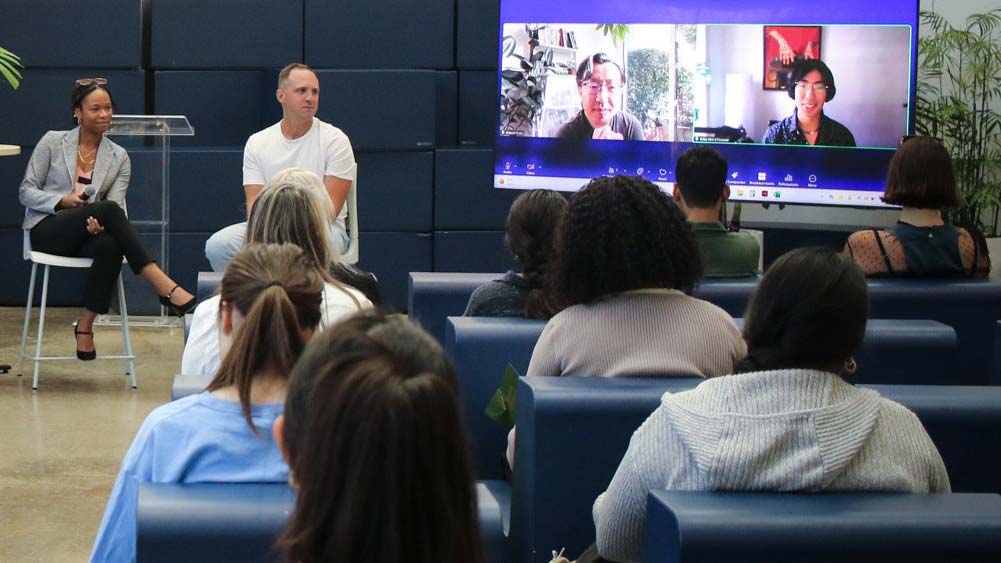
Last month, Taubman College hosted an entrepreneurship panel discussion featuring four architecture and urban planning alumni highlighting their unique paths to starting their own businesses after graduation. Held in the Commons, the panelists shared inspiring stories of start-up triumphs and candid lessons from failures as they discussed how they turned challenges into opportunities and ideas into thriving ventures.
The event was hosted by Taubman College’s career and professional development team, which connects students to the college’s network of more than 10,000 alumni working in nearly 70 countries across a wide range of public, private, and nonprofit entities.
Students were encouraged to ask questions about the panelists’ personal experiences and seek advice for getting the most out of their degrees. The panelists were transparent about their daily schedules, past regrets, life-changing circumstances, and previous work experiences.
More on the panelists and their start-ups is below.
Kyle Hoff, M.Arch ’12, FLOYD
Since launching in 2013, Kyle Hoff’s furniture company, FLOYD, has utilized a practical design philosophy to thoughtfully produce products now living in more than 50,000 homes around the world. Similar to fellow panelist Kitate Kim, Hoff began his start-up with another U-M alum. (“Your future business partner could very well be anyone you meet here,” he said.) During the panel, he was open about some of his greatest challenges following graduation; Hoff shared the failures FLOYD faced designing its second product, and how the company learned lessons through trial and error while staying consistent with its modular design strategy. Through all of it, he said the focus has always been on “Trying not to lose the spark that made the company good.” Hoff urged students to resist constraints as much as possible while in the studio and to use their time at the college to “practice the challenging ideas in your head and innovate with them.” He also emphasized the value in taking a step back when things don’t seem to be working and looking for opportunities that can come from “curves in the road.”
Kitae Kim, B.S. Arch ’16, Foveate
Kitae Kim started his company, Foveate, roughly two and a half years ago with an alumnus of U-M’s School of Music, Theatre & Dance. Foveate empowers architects and designers to create immersive, interactive presentations that bring their visions to life, helping them win more projects and build stronger relationships with clients. Following graduation, Kim worked in art studios, which aligned with his conceptually focused architecture education. During the panel, he discussed how limiting it can be in the field to emphasize theory early in one’s career and the hardships that can result. Kim found his own success through adapting to new ideas and credited Taubman College with teaching him “learning how to learn.”
Ujijji Davis Williams, M.U.P. ‘17, JIMA Studio
Five years ago, Ujijji Davis Williams founded JIMA studio, focusing on enhancing human relationships through landscape and planning strategies. Overwhelmed by the changes brought by the pandemic in 2020, Williams quit a job she genuinely enjoyed. When she decided to start JIMA, several clients followed her thanks to the relationships she had built. Before launching, Williams focused heavily on marketing and business development. She encouraged students to take advantage of complementary courses offered by U-M outside Taubman College. “Take more business classes; you don’t want to be learning so many new things for the first time after you’ve graduated,” she said.
Robert Yuen, M.Arch ’11, M.S.D.M.T. ’12, Monograph
In 2019, Robert Yuen co-founded a software company to revolutionize the performance of architecture and engineering firms. Monograph partners with A&E firms to build custom tools that accelerate workflows. Challenges for the young company included shifting 100% online during the COVID-19 pandemic, only to shift back soon after for the sake of the business, and learning how to properly market a good product. Yuen advised students to learn how money works before going into the workforce and to “Take as many risks as you can, and build whenever and wherever you can.”
— Story by Christina Barber