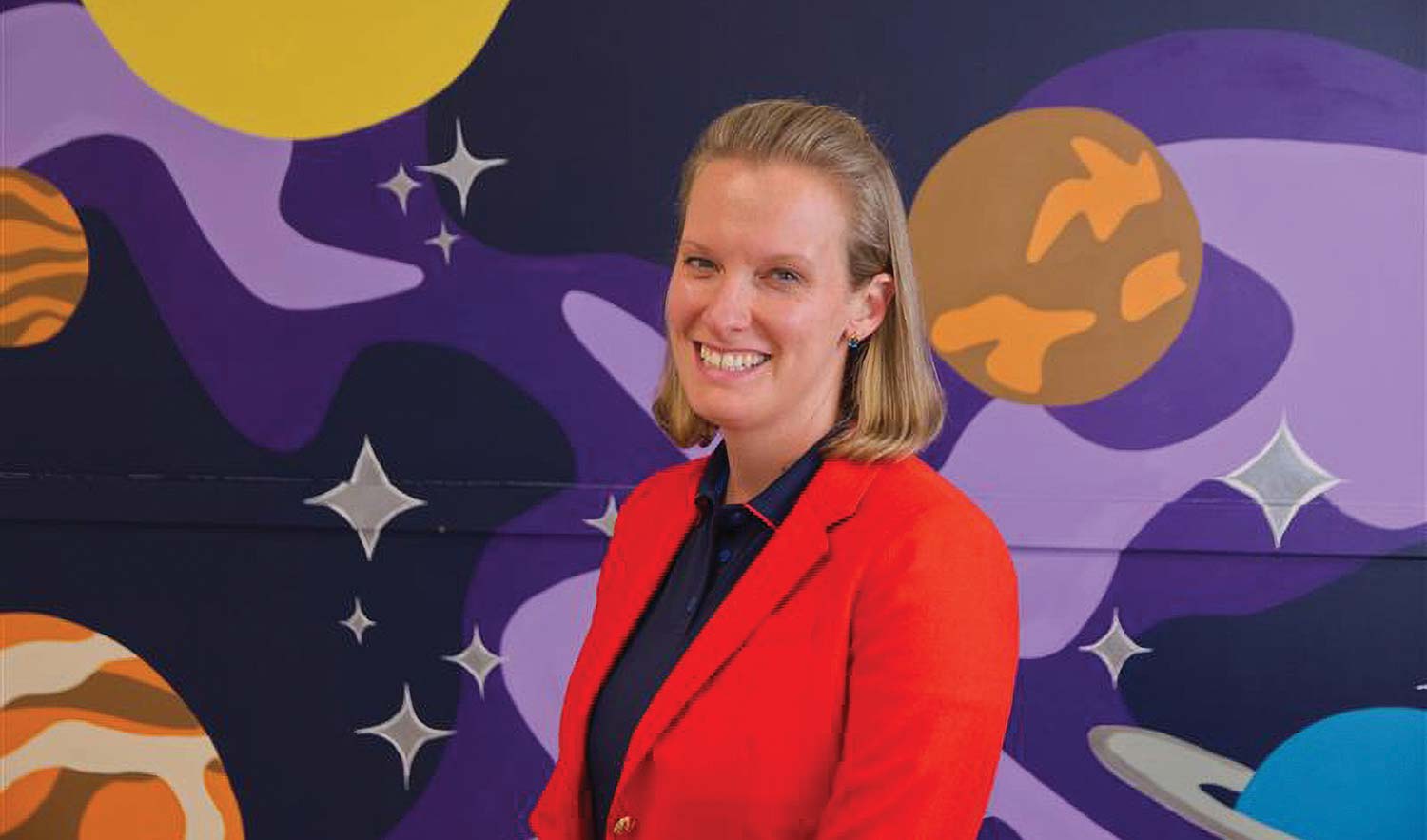
‘A Space Where They Can Exhale’: Motivated by her own cancer journey, Amanda Barbour, B.S. Arch ’09, used her studio lessons to launch centers for immunocompromised children and their families.
Amanda Barbour’s life took an unexpected turn soon after graduating from Taubman College, when she was diagnosed with cancer at age 22. Today, as founder and CEO of the Children’s Healing Center, she credits her education with helping her develop the skills, determination, and design thinking needed to launch first-of-their-kind gathering spaces for immunocompromised children and young adults.
After spending the summer following graduation working for former dean Mónica Ponce de León, Barbour, B.S. Arch ’09, moved home to Grand Rapids, Michigan, to work for AMDG Architects. Frequently sick, she underwent extensive testing that revealed stage four Hodgkin’s Lymphoma, a type of blood cancer typically found in young adults and seniors.“By the time they found it, it had spread throughout my body,” Barbour says.
As a younger adult, she was assigned to a pediatric care team at the children’s hospital in Grand Rapids, and treated with the expectation she would live a long life. There, she met many kids and young adults who, like herself, felt isolated by the experience. “We all understand it now post-COVID, but in 2010, not a lot of people knew what it felt like to be told you couldn’t go into public places or the movies or the mall or to hang out and do normal young adult things,” she says.
She remembers lying in her hospital bed thinking, “How can I use this to shape and inform and help people and places? Wouldn’t it be really cool if we could create a safe and clean space where the kids, young adults, and families I was meeting could interact and play and be normal and form friendships?”
She continued to work throughout treatment as a way to maintain some normalcy and her identity as an architect, but in the background, a different dream was forming — one that applied her knowledge and skills in a new way.
“A lot of the reason that I came up with the Children’s Healing Center and brought it to fruition is because of the education I received at Taubman College,” Barbour says. “I learned to always be looking for how I could improve environments and spaces. I deeply believe that buildings and environments and how they’re designed have the power to impact and influence people’s lives.”
Proof of Concept
After a year of treatment and another year of healing, Barbour started a nonprofit organization in 2011 to explore the idea and eventually opened her first center in Grand Rapids in 2015. Many of her first backers were recent architecture clients.
“I often share that I learned at Taubman College the ability to tell a story and pitch my design idea and concept,” she says. “In the studio, you come up with your project and then you present it to critics and they help improve the idea. That’s basically what I did for five years to get the center open — pitched the center to funders and community supporters and leaders and program experts and asked for their ideas. It was like a larger-scale studio project.”
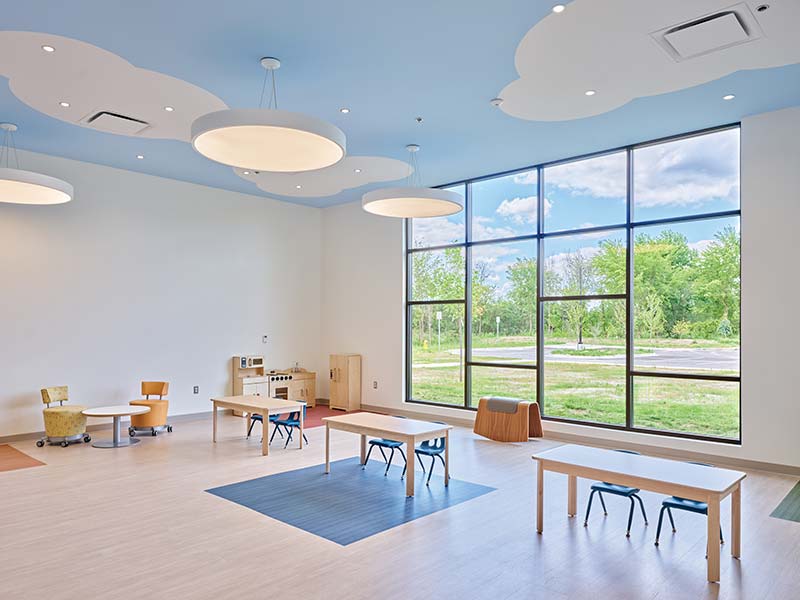
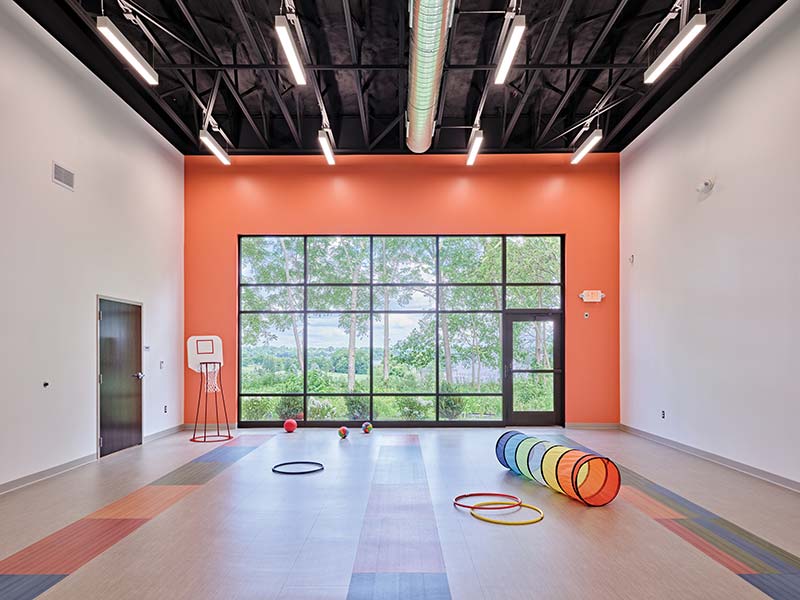
Designed as hospital-grade facilities with HEPA air filtration, water filtration, and no fabric surfaces, the centers also use intensive screening processes and a staff cleaning protocol that allows kids with complex medical conditions and weakened immune systems to participate in a variety of social and mental health focused programming, including after school activities, recreational therapy, fitness, art, and music. The center also partners with local organizations to bring in programs kids wouldn’t be able to participate in otherwise. But it’s the space itself that really makes the difference for kids and their parents.
“Their families and friends don’t understand what they’re going through, but when they come to the center, they can be in a space where they can exhale,” Barbour says. “They’re not worried that their kids are going to get sick or hurt, and they can connect really meaningfully with people who understand.”
Once the first center opened, Barbour realized it could help more than cancer patients, and expansion was soon underway. Then a physician at U-M’s Mott Children’s Hospital contacted her about opening a second center in the Ann Arbor area. With funding from the state and some key donors, the center opened an Ypsilanti location in June 2024 and is currently working with partner organizations to spread the word.
Ask an Alum
To help manage her growing organization, Barbour enlisted Taubman College classmate and longtime friend Sarah Velliky, B.S. Arch ’09, M.Arch ’11, who made the leap from project architect at OX Studio to manager of design & construction at the center in 2022. Velliky already was familiar with Barbour’s mission, having volunteered in Grand Rapids before serving on the board of the Southeast Michigan location. With expansion and construction completed in Grand Rapids and Ypsilanti, she oversees mechanical systems and volunteers at both locations and will lead any future construction projects. Sometimes she misses design work, but the center has plenty of rewards.
“Seeing these kids and hearing their parents tell us, ‘This kid was having a bad day, and then we told them we were going to go to the Children’s Healing Center and their faces lit up and they just got so excited.’ That makes it worth it,” she says.
Barbour has always been something of a trailblazer: Before she was officially an architecture student at Taubman College, she and another classmate convinced the dean to let them join a studio class as sophomores.
“I liked being in the second-floor studio space,” she says. “The energy of the studios and students designing and learning and creating has always been really memorable and inspiring for me.”
After a decade of serving children and families, she’s still using that energy today.
“Taubman College empowers students to come up with unique ideas, and then gives us the tools and resources to create something essentially from nothing, which is really what the Children’s Healing Center is,” Barbour says. “A Taubman education gives you that confidence.
If you have an idea, test it out. Keep testing, iterating, designing, reworking, learning from others, improving, and then executing. It’s the one thing I learned that helped the centers open and be in the growth phase we are today.”
— Eric Gallippo