At the Frontier of Data-Driven3D Concrete Printing
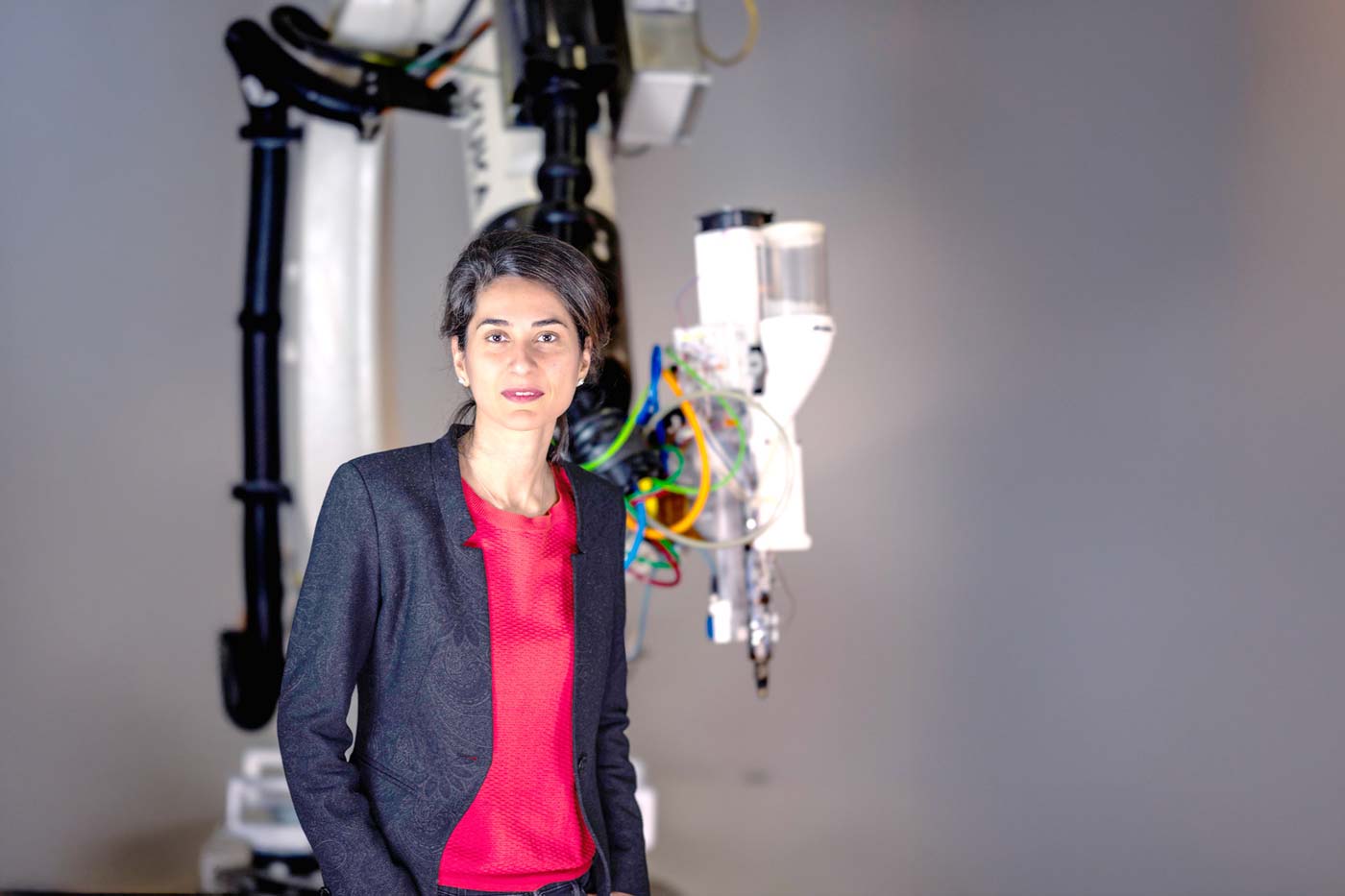
Backed by an NSF CAREER Award, Assistant Professor Mania Aghaei Meibodi and her team are pushing the field forward.
Today’s built environment is under significant pressure from multiple complex challenges, including material and labor shortages, ambitious energy goals, and climate risks such as flooding, earthquakes, and wildfires. To Mania Aghaei Meibodi, assistant professor of architecture at Taubman College, these overlapping challenges present an opportunity to pursue design and construction processes that address all of them at once. “Adopting 3D printing and machine learning will elevate the built environment, and the lives of people and other species, by expanding what we can design and build, boosting performance, enabling mass customization, raising productivity, and cutting waste,” she says.
Aghaei Meibodi is a leader in developing novel computational design and fabrication methods for large-scale manufacturing in the building industry. She says machine learning’s capacity to analyze thousands of measurements enables it to spot patterns humans miss, opening new doors for 3D printing intricate geometries at scale.
“It works with designers to predict and even generate high-performance components, and it recommends manufacturing settings so parts are built right the first time, with data to back it up.”
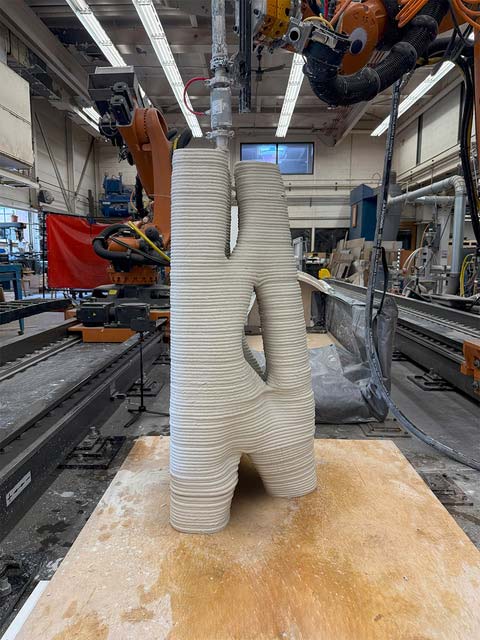
High-performance elements are inherently complex, not as a goal, but rather from integrating multiple functions into a single part. Aghaei Meibodi says that complexity becomes an opportunity with 3D printing rather than a constraint.“The integration of robotics and 3D printing has demonstrated strong potential to produce high-performance parts that are material-optimized, structurally superior, lightweight, and capable of combining multiple functions within a single manufacturing process.”
Realizing this opportunity requires two key developments: 1) tools and computational models that allow architects and engineers to design high-performing, printable building components, and 2) robust robotic 3D printing systems capable of fabricating complex geometries without extensive trial-and-error.
Aghaei Meibodi and her interdisciplinary team at Taubman College’s Digital Architecture Research and Technology (DART) Laboratory have spent the last five years working on these developments. In July, she received a prestigious National Science Foundation (NSF) Faculty Early Career Development (CAREER) Award for her proposal based on their research: “Data‑Driven Extrusion‑Based Robotic Three‑Dimensional Printing of Reinforced Concrete.” The five-year NSF grant supports the lab’s efforts to develop intelligent robotic printing methods that can produce scalable “first-time-right” high-performance building elements.
“It’s an opportunity for us to be at the frontier of the field,” she says. “We will have the support to develop new models, research direction, and education curriculum.”
The work is incredibly challenging due to the shifting physical properties of concrete and the large data sets required to train machines to print complex geometries. But overcoming these challenges could radically change the construction industry — reducing harmful environmental impacts, addressing housing shortages, creating desirable jobs, and spurring innovative design, technology, and construction businesses by opening the door to producing high-performance concrete elements that inherently entail complex geometries.
“Concrete is a very unforgiving material,” Aghaei Meibodi says. “It’s super soft, and then, when printing it, you want to immediately solidify it while maintaining the structural integrity of the part being printed. Once you start dealing with complex geometry, you are facing deformations and collapse at all times.”
As a result, she says the current building elements that can be robotically 3D printed with concrete aren’t better aesthetically or functionally than what can be built with traditional formwork.
DART’s goal is to develop machine-learning geometric models that learn directly from the printing process, as well as part performance during and after fabrication. First, the team will identify which data are meaningful to capture — spanning design (geometry and targets), materials, robotic 3D-printing process signals (paths, speeds, pressures, temperatures), and other metrics (bead height, voids, cure state). Next, they will model and process the data to train machine learning systems that predict printability and performance; generate new, high-performing, printable geometries; and recommend control parameters for first-time-right fabrication, with closed-loop adjustments if conditions drift. Finally, they will validate the approach through large-scale demonstrators, running printers with real-time feedback, benchmarking against conventional methods, and publicly exhibiting the results.
“These forms are very complex, and they need models that are beyond manual modeling or existing coding,” Aghaei Meibodi says. “It will need a collaboration between humans and AI to suggest forms that are reliable for printing, because the parameters that guarantee success are too many. There are too many challenges to be considered by a single person. But data collection and AI can help solve this complex problem.”
The funding also supports the development of new curriculum and educational outreach to broaden participation by learners of all ages and skill levels and train the workforce necessary to take on new, highly skilled roles. At Taubman College, two new courses are in development, one at the M.Arch level focused on data collection, data-driven modeling, and AI for robotic 3D printing, and another for B.S. Arch students with a focus on more basic concepts. There are also plans for a workshop series introducing robotic construction and 3D printing, where students can experiment and become familiar with the tools. For young learners, the team is creating a toy building set that emulates the geometries and processes of successful 3D printing.
“AI-driven, robotic 3D printing in construction will create new job opportunities and spark educational programs that don’t yet exist,” Aghaei Meibodi says. “We will need a lot of skill sets within the next generation.”
To Aghaei Meibodi, the larger goal, and what the field still lacks, isn’t to replicate with robots what conventional concrete formwork already does, but to develop technologies and processes that can reliably print a wide range of forms and enable advanced building elements. As the industry adopts these technologies, she expects new markets and opportunities to emerge alongside collaborations spanning robotics, computer science, materials science, architecture, engineering, and entrepreneurship.
“You could imagine startups that specialize in 3D printing homes or specific building elements,” she says. “Others might reinvent the elements themselves, developing new print technologies, novel materials, smarter control systems, or design workflows built for additive manufacturing. As these efforts converge, we’ll see breakthroughs we don’t yet anticipate. What exists is only the beginning.”
— Eric Gallippo