What’s Next for Urban Tech
Taubman College’s first-of-its kind Urban Technology program keeps evolving to meet the needs of today’s students and cities.
When looking for colleges five years ago, T.F. Chen, B.S. Urban Tech ’25, was excited by a brand new degree he’d learned about at the University of Michigan, one that focused on planning and designing for technologically advanced cities. He was also accepted to a traditional architecture and planning program in his home country of Canada, but it didn’t feel like the right fit for him. His heart was set on Urban Technology.
“As someone who is very enthusiastic about cities and who wants to be more involved in designing and planning for cities and the capabilities of handling these new urban systems that are emerging, I decided to bet on this program and come to Michigan,” Chen says.
Today, that bet has paid off; Chen started working in his dream field for a transportation consulting firm in San Francisco earlier this year. Like others from his inaugural graduating cohort, he learned to work through the ambiguity of studying an emerging discipline and appreciates the strong bonds developed along the way.
“It’s almost like we were all creating this curriculum together, even as students, helping the faculty shape it for future cohorts through feedback about the classes, the trips we took, the career opportunities we were exposed to,” Chen says.
And the college has responded, with new offerings, new requirements, and some new approaches to graduating the world’s first urban technologists.
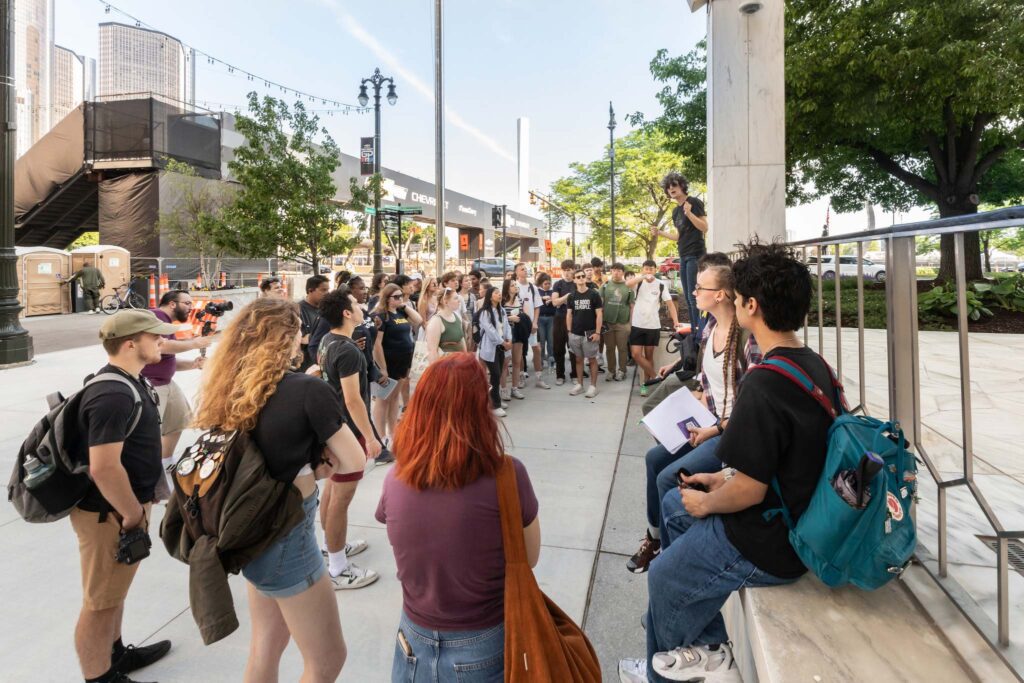
Students during a Cities Intensive trip, Detroit, MI.
“Building this unique degree with faculty, alumni, industry experts, and expert staff was a highlight of my career,” says Jonathan Massey, dean at Taubman College of Architecture and Urban Planning. “Even better has been seeing students respond with intelligence, creativity, and passion. They have co-created this degree by shaping its curriculum and culture profoundly.”
Bigger than the Classroom
For the first time this fall, incoming Urban Technology students started their Taubman College journey in late August, as opposed to January. Bryan Boyer, faculty director of the Bachelor of Science in Urban Technology degree, says the change added some excitement for the new cohort — and it’s not just because of the better weather.
“There’s always a certain level of energy when the fall semester starts,” Boyer says. “It’s exciting to begin the year with vitality, not just in our program, which has always been there, but really across campus. So now we’re fully participating in that fall groundswell of activity that occurs all across the Ann Arbor campus, which is awesome.”
Helping to generate more excitement, the program released a new video in August produced by Lunar North. It combines bright, colorful animation with student and faculty insights on what Urban Technology is and why it should be studied. That energy can also be attributed to more students in the building, with the incoming cohort of 60 tripling the size of the inaugural group, and a total of 170 students across cohorts. And with the experience of four previous cohorts to draw on, Boyer says students are entering as the “most informed” to date.
The curriculum was also adapted to better support students academically. Previously an elective course, Urban Informatics, taught by Xiaofan Liang, assistant professor of urban and regional planning, is now a required course. For students more interested in entrepreneurship and innovation, new courses in Foresight and Prototyping add nuance to the way students learn about design.
“These additions to the curriculum come from seeing how students have navigated the program and two clusters of students that emerged for us,” Boyer says. “There’s a group of students who are more interested in analytics — using sensors, data, and computational power to understand how cities operate and urban outcomes. The other group is more excited about creating stuff. That could be somebody who wants to become a UX designer, an entrepreneur, or someone who wants to create new government policies and programs.”
To teach these expanded offerings, the program hired four faculty members in 2025, including two recent doctoral graduates from M.I.T.: Wonyoung So, Ph.D., specializes in data visualization and equitable technology; and Sheng-Hung Lee, Ph.D., brings a focus on planning for longevity in urban environments. Joining as professors of practice, Ron Bronson and Violet Whitney have both taught courses previously. Bronson will teach service design in the winter, and Whitney will teach an elective on “spatial computing” that will eventually seed into the new prototyping class. Continuing with the program are Emily Kutil, M.Arch ’13, lecturer in architecture, who has been co-leading the program’s Cities Intensive, and Lisa Sauvé, M.Arch ’11, M.S. ’14, assistant professor of practice in architecture and co-founder of Synecdoche design studio, who brings a background in design and entrepreneurship.
“It’s really important for us to have a balance of tenure track and practice track people who can bring deep structured thinking in addition to more emergent professional insights,” Boyer says.
Two things that won’t change are a commitment to engaged learning through exercises like the Cities Intensive, which brings students to three urban areas — recently, Ann Arbor, Detroit, and Chicago — to observe and explore before co-drafting their own model metropolis, as well as an emphasis on studio-based learning.
“Our studio-based pedagogy really gives us a different environment in which to educate the students compared to other tech-focused programs,” Boyer says. “It’s a more intensive setting. They have more contact with professors. We’re able to get into some nuanced problems and develop interesting ideas about how we might respond to those out in the real world.”
Another thing that has been consistent is the bond among students. “My hope when we started this, is that the students would get an education that’s bigger than the classroom,” Boyer says. “And what I saw with the first cohort, and I see in the subsequent cohorts as well, is that there’s a strong bond. We’re big enough that you don’t get tired of working with the same people all the time, yet small enough that you get to know everyone, and we can be a little community within the village of Taubman College, within the metropolis of the University of Michigan.”
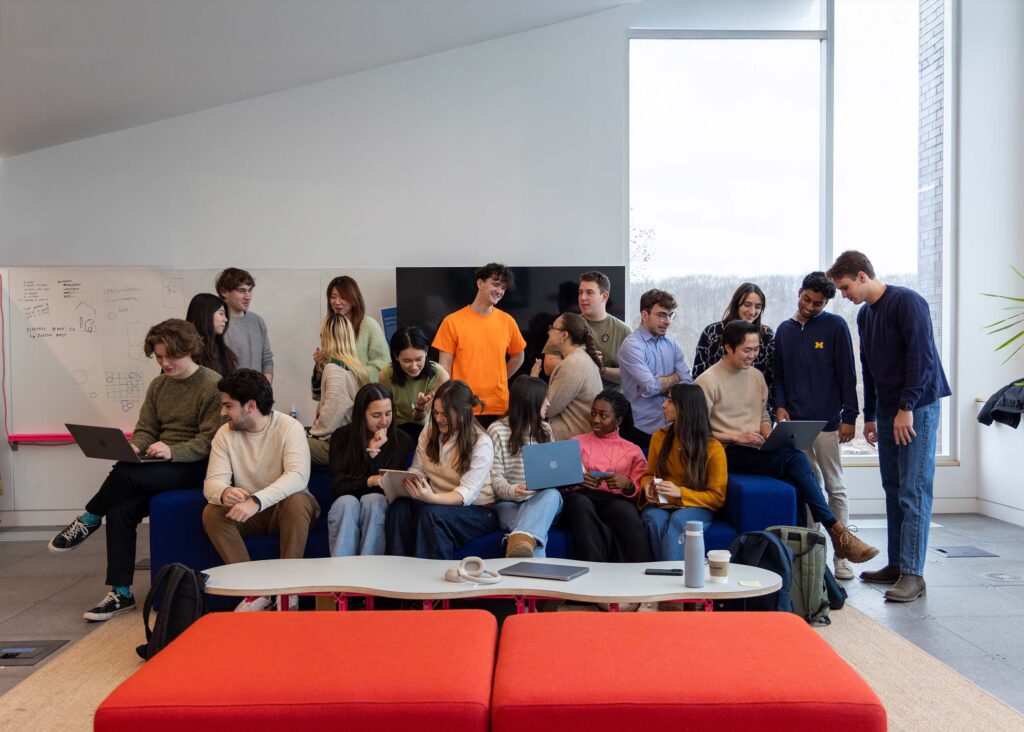
Class of 2025, the first graduating class of Urban Technology students, in the studio space.
Urban Technology Alumni Experiences
Aakash Narayan, B.S. Urban Tech ’24

As a development analyst for Landmark Properties, Aakash Narayan, B.S. Urban Tech ’24, spends a lot of time thinking about one question: “Why would someone want to live here?”
Landmark is an Atlanta-based real estate firm specializing in student housing communities around the United States, the UK, and Ireland. Narayan was hired there over the summer after completing an internship in 2024.
Working with a team, he helps analyze sites by calculating risks and predicting financial performance. It’s fast-paced work that requires quick thinking, teamwork, and iterating in real time to keep projects moving forward on deadline. The qualitative data analysis falls in line with his urban planning coursework when it comes to zoning codes. But ultimately, he needs to determine what will make an urban area attractive to tenants. “That human-centered approach of putting yourself in someone else’s shoes and using that thought process to carry out all the other functions,” was learned in the urban technology program.
“I’m creating a lot of the assumptions for the financial model,” Narayan says. “Does it make sense to add retail here? How much is the retail rent? What kinds of tenants would we get? A lot of it boils down to analyzing a place and why someone would want to live there, and then a lot of the financial metrics are taken from answering that singular question.”
While at Taubman College, Narayan also co-founded the Urban Technology Student Organization (UTSO), where he learned to get creative with securing funding and organize and plan meetings — skills he still employs today. Although his work is far from what he was doing in his upper studio courses, Narayan says the basic principles are central to how he operates. “That kind of workflow that we had in studios is my workflow here,” he says. “Knowing how to take feedback and adjust, and all of those kinds of intangibles from the Urban Technology course structure, that’s replicated here.”
Hannah Bernstein, B.S. Urban Tech ’25

When Hannah Bernstein, B.S. Urban Tech ’25, started at U-M, she knew she wanted to make an impact in the field of sustainability. After starting with the College of LSA with plans to enter engineering, she considered transferring to the School for Environment and Sustainability before making the move to Taubman College during her junior year.
“Urban Technology specifically seemed like a good mesh of all of these different interests, because it was multidisciplinary, and I liked the size and focus of the program,” she says. “Even though it’s broad and you can do anything with it, it also seemed more like I could do exactly what I wanted, which was to work on sustainable development.”
Today, Bernstein is a renewable development analyst with global clean energy company Invenergy, where she acts as liaison between stakeholders, including landowners, engineers, environmental protection agencies, lawyers, and community leaders, while ensuring respect for the land itself. Although she’s based in Chicago, the team she works with is focused on developing scalable renewables — including solar and onshore wind power and battery storage — in Michigan, which “hits close to home” for the Ann Arbor native.
Bernstein first connected with Invenergy through an internship in 2024, during which she helped analyze prospects for new developments based on Geographic Information Systems data and other inputs from previous projects to help determine which sites might be most viable and how responsive landowners might be. She credits her Urban Technology background with developing her critical thinking and comfort with working across sectors. A class in stakeholder relations — UT 201 Change-Making in Cities — was especially formative.
“The coursework really focuses on a large range of different factors that play into each other, which is the same thing that I’m doing with renewable energy development,” she says.
T.F. Chen, B.S. Urban Tech ’25

Ever since he was a kid, Chen has been fascinated with cities and transportation.
“I used to draw fantasy maps and imagine what cities would look like,” Chen says. “I would sketch spaghetti networks of highways and train networks.”
So when the Taubman College Career Fair helped connect him with an internship with San Francisco consulting firm Fehr & Peers in 2024, it was a dream opportunity years in the making. While there, Chen applied his experience from coursework to take the lead on a community engagement session. Drawing from Urban Technology principles, he developed survey questions and a scavenger hunt activity that got residents thinking about their neighborhood, what improvements had been made already, and what needs they still had.
Earlier this year, Chen was hired as Engineer Planner I with the firm, where he now works on data visualization and mapping to help tell the story of how the firm’s transportation projects are improving communities, as well as community engagement to ensure its recommendations are appropriate for not just the physical environment, but also the culture of local residents.
Looking back on his time in the Urban Technology program, he says being among the first to go through and have a hand in shaping it gave him and his cohort a shared sense of confidence.
“There’s this kind of common sentiment between the people in our cohort: ‘If you have something uncertain, come to us. We’re used to it. It’s all good.’”
Creating Curriculum, Together
In an August newsletter to students, Boyer noted that, since its inception, the Urban Technology program has been working to define itself. Those definitions have focused on the combination of urbanism, technology, and design; the ways data, connectivity, computation, and automation affect how we experience and shape cities; and the digitalization of the built environment. This year, a new definition emerged, one that encompasses all of the above: a new liberal arts for the urban era.
When describing their degrees to peers, colleagues, and potential employers, Narayan, Bernstein, and Chen all get the same responses: “What is that?” or “Tell me more.” The answers vary depending on who’s talking and who they’re talking to.
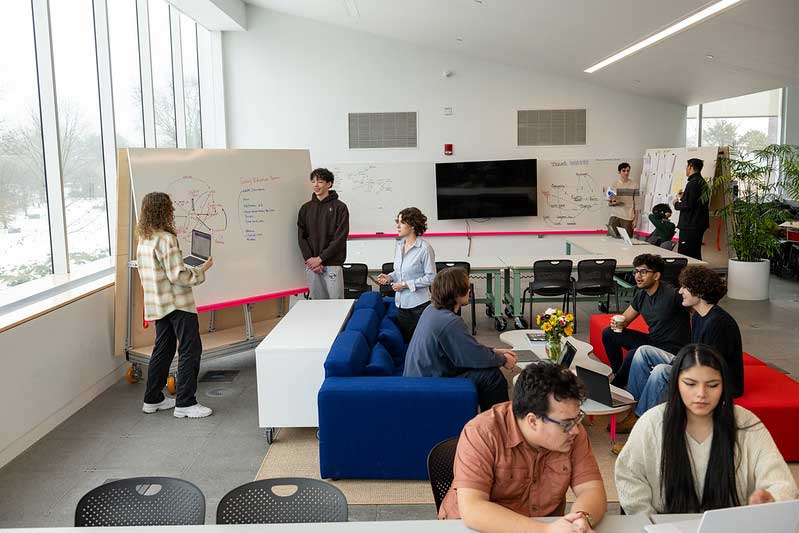
Students collaborating in the Urban Technology studio at Taubman College.
“Once you find your pitch, a lot of people get pretty excited about what it is and what your background is,” Narayan says. “A lot of times I describe it as an urban planning degree with a data design component.”
“I give the spiel that it’s cities, design, and code, and it’s kind of like a layer on top of urban planning,” Bernstein says. “But to me, it means sustainable development; that’s why I pursued urban technology.”
As for their own feedback for the program and future cohorts, Bernstein recommends students try some projects outside of their focus area, if just for the added experience with a new set of problems or tools. Looking back from his current role, Narayan suggests more exercises with grounded parameters, where students design solutions for real-world time and budget constraints. Chen is excited about the prospect of the new prototyping curriculum and a deeper integration between coding and design.
“What sets Urban Technology apart, to me, is the culture we have, not just as a cohort, but the entire program,” Chen says. “There’s a community that’s like, ‘Let’s do this together, let’s build this and shape this curriculum together,’ which is something I really appreciate.”
— Eric Gallippo
Main Image: Video still from the “Smart Cities Start With You” urban technology video, produced by Lunar North (2025).