


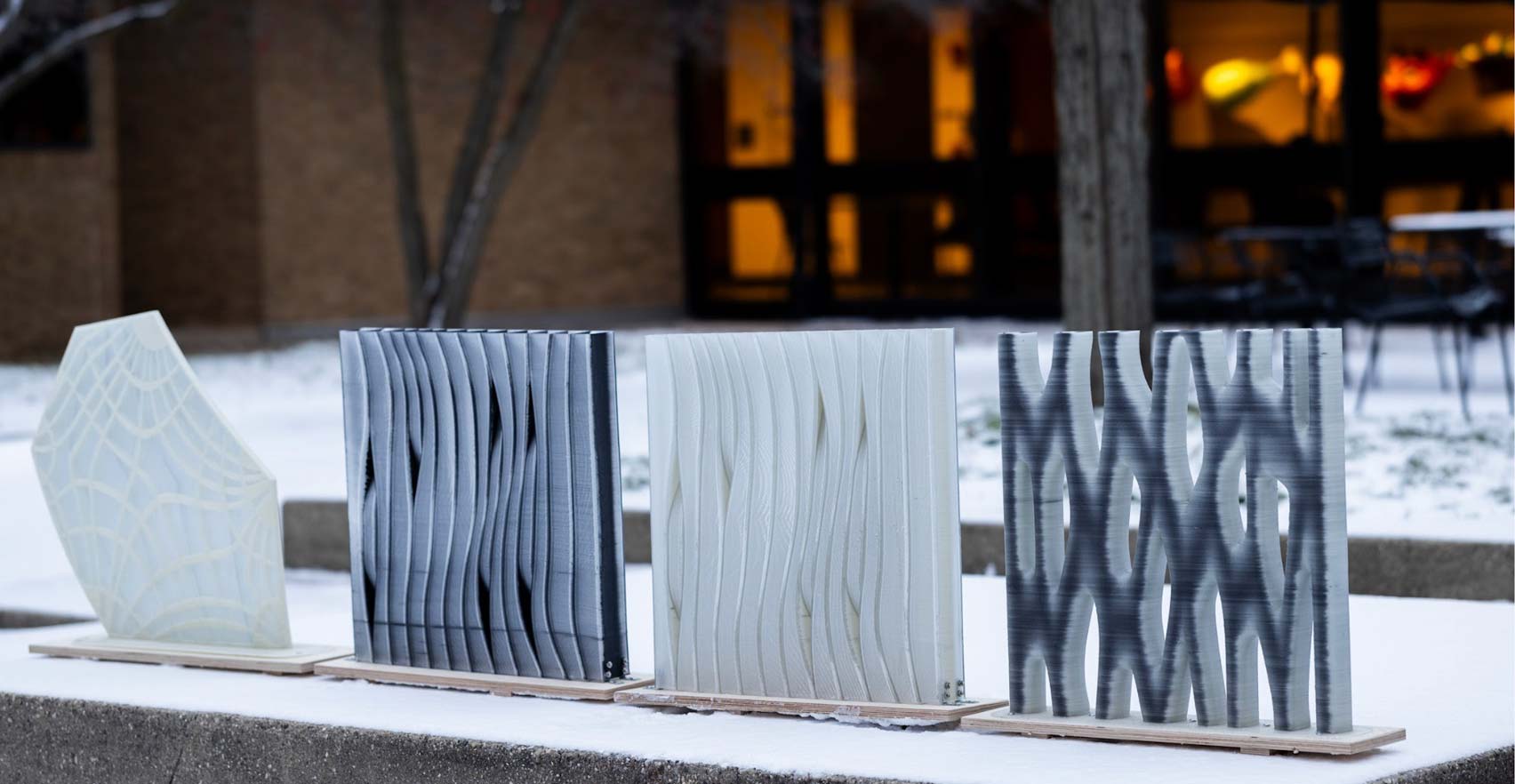
Functionally Graded Material: Performance Through Continuous Material Variation
[April 2024 – Present]
This research explores the potential of functionally graded, multi-material additive manufacturing (FGAM) to produce high-performance, materially efficient building components. In architecture and construction, this local tailoring can address daylight transmission and structural performance by creating components with materials possessing tunable stiffness, such as fiber-reinforced composites. The main objectives include optimizing geometry and material performance for both structural integrity and passive solar thermal control, establishing a robust design framework for functionally graded materials, and evaluating the effectiveness of FGAM through structural tests. The methodology involves developing novel hardware and software tools for large-scale polymer additive manufacturing using a dual-screw pellet extrusion system for precise multi-material deposition. A computational design framework is used to optimize the variation in material properties across a component. The system was evaluated by building and testing full-scale prototypes. Results show that material composition and rib geometry significantly affect angular light distribution, transmission stability, and daylight availability. This work was funded by the Taubman College Pressing Matters program.
[GEOMETRIC THERMAL PERFORMANCE]
Student research assistants include:
- Alireza Fazel – Ph.D in Architecture
Faculty:
Wesley McGee
Rachael Henry
