


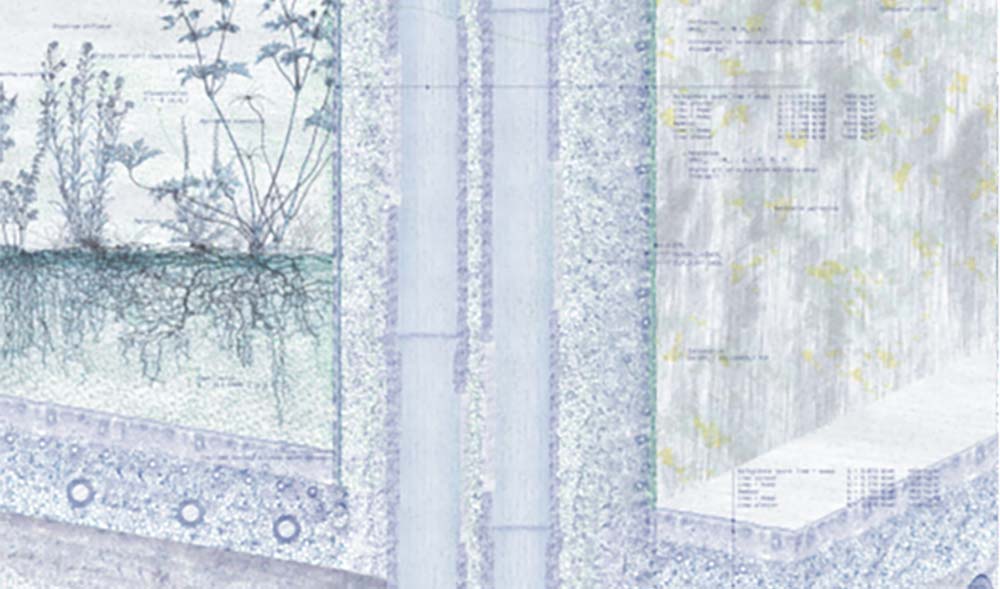
Zero Emission Dehumidification Device
Built from bio-based hempcrete — a porous mixture of hemp and lime — Junghans and Schenk’s device reduces a room’s humidity by absorbing it through capillary condensation and drying by high air velocity produced via solar chimney; as solar radiation is absorbed by the chimney’s darkened, external surface at the top of the duct, it creates an updraft that increases air velocity. This drying effect on the surface then causes moisture in the capillaries of the hemp to move from the room-facing surface to the backside of the porous wall. “This principle is causing an ongoing dehumidification effect for the room if the air velocity and/or solar radiation is high,” Junghan says. The idea is to provide an alternative to traditional methods of dehumidifying buildings, which typically require large amounts of energy used to power air conditioners or chillers. Others involved in developing the passive dehumidification device were Lisa Mandelartz Schenk, Hai Jie Tan, and Tijs Vangenechten, of Shenk.zone, and U-M students Srihitha Nimmagadda and Pranavi Gudi.
[BIOMATERIALS]
Completed illustration by Schenk.zone
Project collaborators of Shenk.zone includes:
- Steven Schenk
- Lisa Mandelartz Schenk
- Hai Jie Tan
- Tijs Vangenechten
Student research assistants include:
- Srihitha Nimmagadda
- Pranavi Gudi
Faculty:
Lars Junghans
