Urban Technology students design their ideal metropolis for The Incomplete City workshop
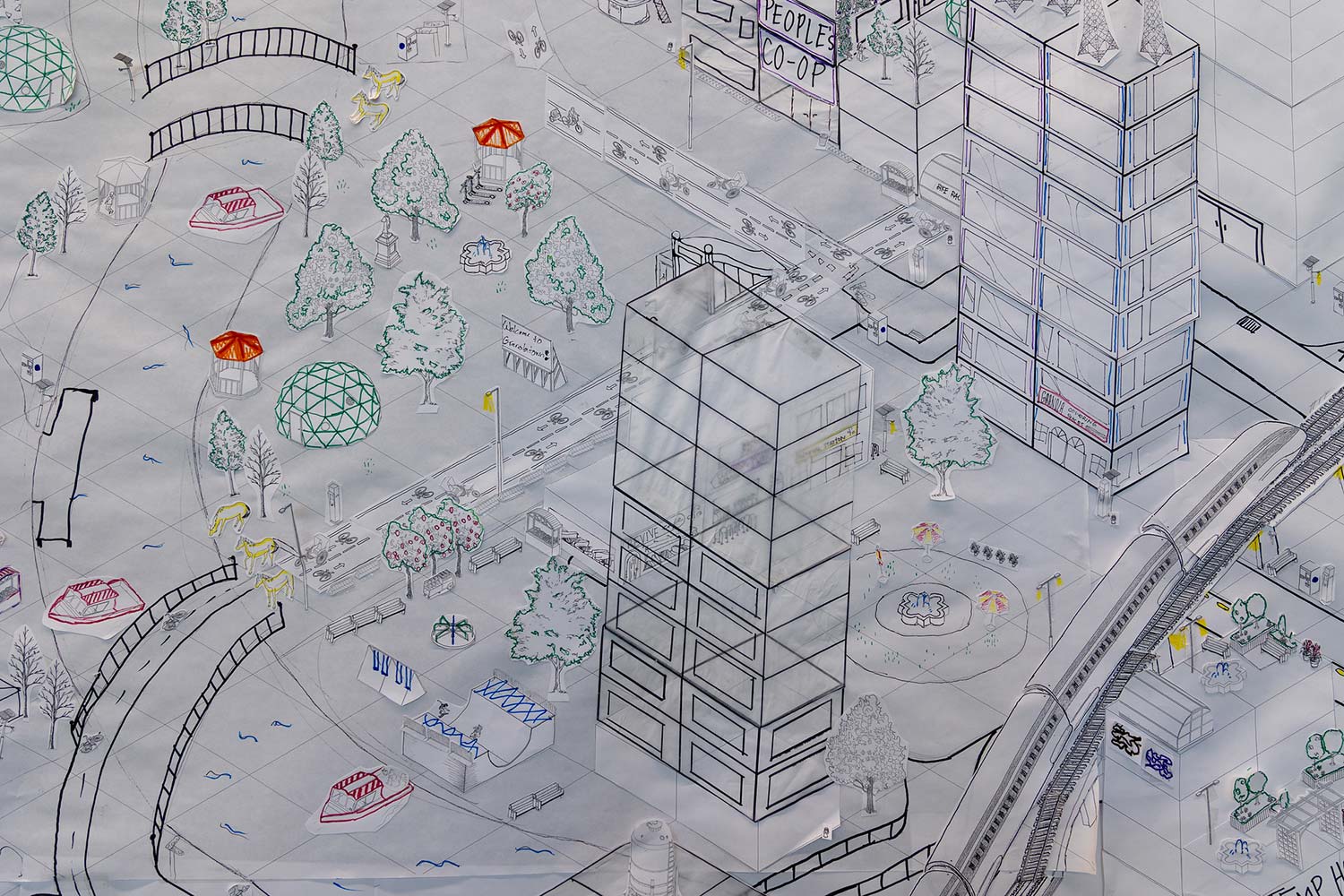
Later this week, urban technology students will spend two days designing and critiquing their own city as part of the final installment in the program’s fall Cities Intensive exercise. Over the summer, the Taubman College Newsroom sat in on the spring cohort’s workshop, where students worked in teams to develop smaller municipalities that grew and merged into a single city.
Three residents walk around their new city. One of them, an avid teenage parkourist, is impressed by the ramps and accessibility of a new neighborhood dedicated to their friend, a wheelchair user in their 20s. After a few hours of exploration, they sit down to watch the third resident, a skater and Japanese immigrant who knows minimal English, move around the skate park like a duck in water.

These three were just a few of the 10 user groups imagined by students in the Taubman College urban technology program during the spring Incomplete City workshop, held during the last week of June. An integral part of the program’s Cities Intensive sequence, the Incomplete City prepares students for studio work by having them design a city from scratch. Starting with separate villages, the students negotiate around their stakeholders’ various conflicting interests as they work toward coalescing into a single municipality.
Students used knowledge gained from class visits to Ann Arbor, Detroit, and Chicago to imagine what their ideal city should look like. At the start of the workshop, groups had to design a town for 100 residents. However, instructors Matthew Wizinsky, associate professor of practice in urban technology, and Emily Kutil, a lecturer in her second year teaching the course, instructed students to gradually increase their towns’ populations and densities at various points during the exercise. Over the course of only a few hours, students developed new housing and infrastructure for 250, 500, and eventually 2,000 residents before combining their towns into one city.
“I hope that they maintain in their minds the ways in which the Incomplete Cities exercise simulated the negotiations, tensions, and conflicts that arise in urban environments,” Kutil said. “It’s easy as a student to try and visualize your utopian world without the constraints of the existing world pushing back against them.”
Students in the spring cohort took a grounded approach to their cities, highlighting the experiences of immigrants, aging individuals, and people with disabilities. To ensure that the city ran smoothly, students split into six commissions evocative of real city governments: the transportation commission; the water and utility commission; the parks and public space commission; the commission on aging population; the commission on youth; and the commission on safety and accessibility.
Lucas Tsetskhladze, B.S. Urban Tech ’27, served on the transportation commission, which was tasked with integrating disparate bus, train, and metro systems across the villages into a single municipal system. He said the experience prepared him for future user-centered design studios.
“It shows how you should be open to other people’s priorities,” Tsetskhladze said. “After all, we’re all thinking of the city as a whole. It’s not like ‘I want this, that guy wants this.’ We should all think about what will benefit everyone. That negotiating is something we’ll have to do all throughout life.”
— Story by Joshua Nicholson