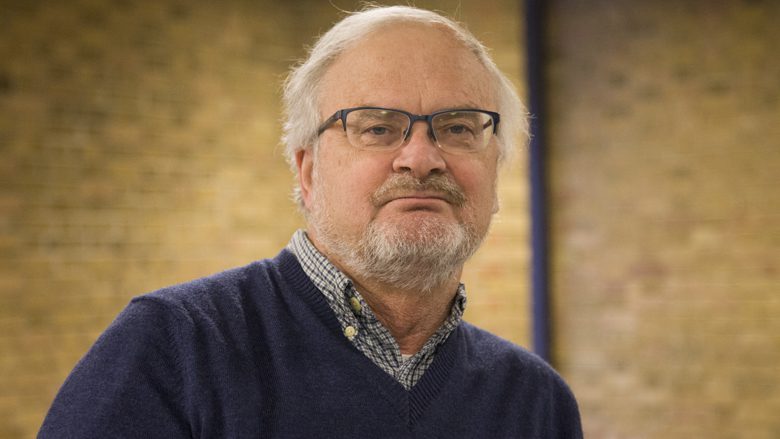
Connecting the Dots: Professor Martin Murray is working to shed light on a ‘new kind of urbanism’ taking shape in Detroit and around the world
Martin Murray’s latest research in Detroit has its roots 4,000 miles away in Germany’s Ruhr Valley, a region once home to a booming coal and steel industry. As employers left and towns shrank, Germany invested in transforming the abandoned infrastructure into public parks and historic monuments, explains Murray, professor of urban planning at Taubman College.
Murray has long researched places like the Ruhr post-industrial region and others globally. He’s written a number of books and articles exploring, “What happens to these leftover spaces right after abandonment?” When COVID halted global travel five years ago, Murray turned his focus closer to home. He and his Taubman College colleagues María Arquero de Alarcón, associate professor of architecture and urban and regional planning, and Olaia Chivite Amigo, M.Arch ’18, and recent architecture fellow, began studying patterns of distress in five Detroit neighborhoods.
In April, Murray received a prestigious Guggenheim Fellowship — one of 198 out of 3,500 applicants. The fellowship recognized his scholarship and his upcoming book, which connects dots between Detroit’s current realities through research countering both “apocryphal” tales of a “destroyed city” and recent boosterism over its thriving sports and entertainment district. “The argument is that decline is uneven, and that what happens in those spaces is very much tied to the process of abandonment,” Murray says. “If you go to the seven square miles along Woodward Avenue, you’ll find a vibrancy, but you don’t have to go very far to see that that’s very limited.”
His research draws on Brightmoor, Delray, Mapleridge, Poletown, and Riverbend — neighborhoods challenged by vacancy, abandonment, foreclosures, and diminished municipal services. Murray says a “kind of triage” is occurring, with some areas willfully neglected so others can be prioritized. “The city administration has basically decided that there are places they’re going to do nothing for,” he says. “They’re going to talk about doing things, but in fact, nothing is going to happen.”
In Delray, for example, residents face some of the worst pollution in the country due to overindustrialization. When the city offered a buyout program, few people qualified because so few were longtime homeowners.
Most funds for Detroit’s struggling neighborhoods come through private philanthropy and foundations and are devoted to projects like artist collectives and urban farms, Murray says. But with limited schools, social services, or even traffic lights, it’s hard to imagine these small-scale projects sustaining neighborhoods long-term. “What is happening in Detroit is an experiment with a new kind of urbanism,” Murray says. “What happens when the state agencies that offered a balance between private investment and public services begin to wither and fall apart?”
Research for his book-length manuscript is based on ethnographic fieldwork, including interviews and reviews of public records and journalistic accounts, as well as “walking the streets.” One clear comparison for Murray is Johannesburg, South Africa, once the world’s premier site for gold mining. The city now features extreme wealth next to widespread hardship after mining’s decline. Gated communities offer exclusivity for some, while other areas lack consistent public utilities and services. “There are a lot of cities in the world that are experiencing something very similar to Detroit,” he says.
It’s not just a lack of resources, but speculative investors extracting what little remains. Murray says these investments leave few homes for purchase, with landlords charging high rents and offering “predatory” rent-to-own schemes. “It’s not the absence of a market: It’s the actual working of the market,” he says.
Murray hopes that this collective research project can raise awareness about deindustrializing cities in distress.
— Eric Gallippo