


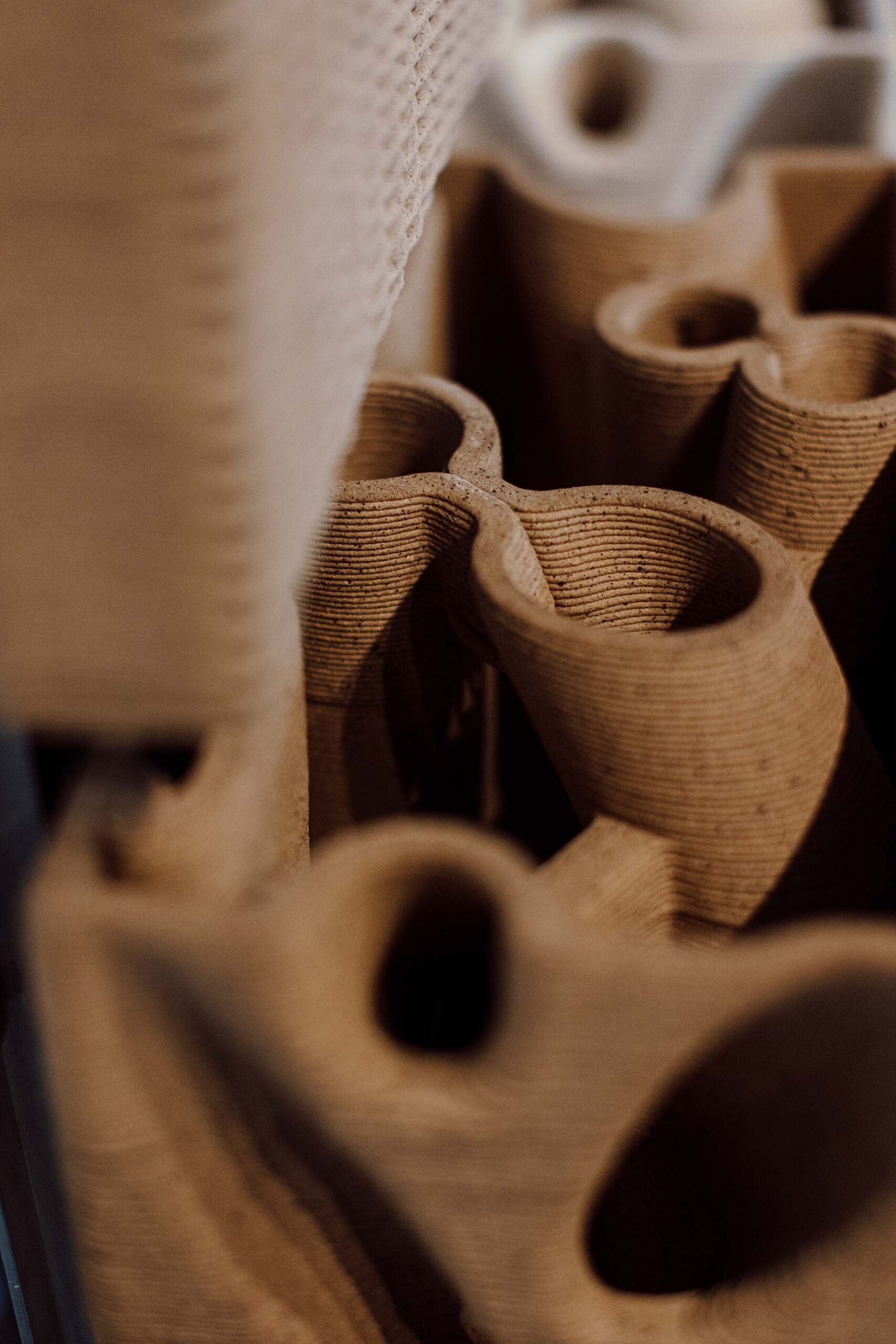
Hygroscopic Envelope: Building enclosures for climate adaptation
[2024 – Present]
This project explores how 3D printed (3DP) ceramic facades can enable climate adaptation and resilience by collecting, retaining, and controlling release of stormwater. It advocates a paradigm shift for the building envelope, away from the conventional “rain screen” notion that facades must repel and shed water off the building, to one that directly engages and manages water in ways that benefit broader infrastructural and ecological systems that are vulnerable to the impacts of climate change. The research explores how modular 3DP ceramic components can absorb and delay runoff. The work operates at three interrelated scales—the micro (material), the meso (component), and the macro (aggregated assembly)—to develop an integrated understanding of how material performance and the design of modular systems can beneficially interface with buildings, landscapes, and other stormwater infrastructures.
[BIOACTIVE ENVELOPE]
Project collaborators include:
- Adam Marcus – Tulane University, Architecture
- Liz Camuti – Tulane University, Architecture
- Evgueni Filipov – University of Michigan, Civil & Environmental Engineering
Faculty:
Tsz Yan Ng
Wesley McGee
