Clutter and Peñarroyo’s ‘Time Capsules’ explores spatial arrangements and media consumption at 2025 Chicago Biennial
New work by architecture faculty McLain Clutter and Cyrus Peñarroyo exploring time, attention, and spatial arrangements of media consumption is on exhibit now at the 2025 Chicago Architecture Biennial.
This year’s Biennial, Shift: Architecture in Times of Radical Change, features nearly 100 participants, including Clutter and Peñarroyo’s design collaborative, EXTENTS, from 30 countries and runs through February 2026 at the Chicago Cultural Center and other venues across the city.
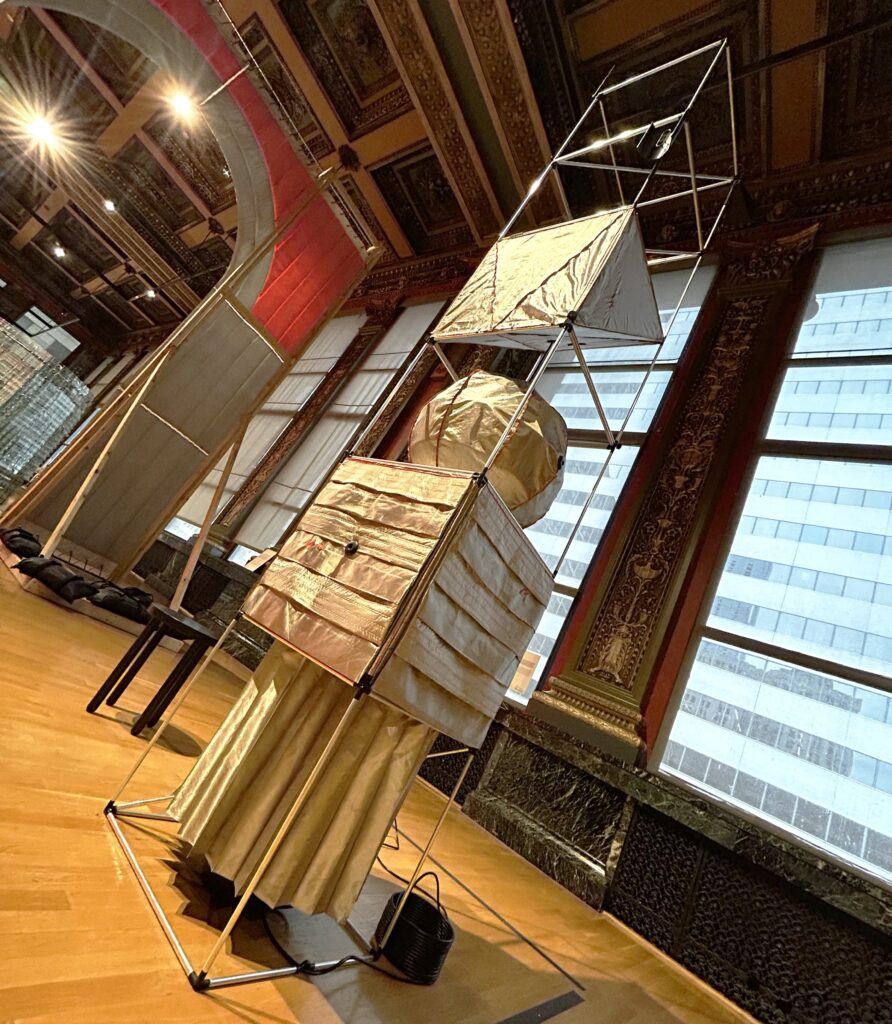
Their project, “Time Capsules: An Anti-Antenna for the City of Chicago,” examines how alternative spatial arrangements of media consumption might disrupt contemporary media habits. Through the creation of a raree, an antique spatial format of collective media consumption — one that starkly contrasts today’s increasingly isolated and insular media formats — the project stages new relationships between people, space, and technology to critique contemporary media formats that extract and monetize our attention, foment societal division, and speciously evangelize innovation.
According to Clutter and Peñarroyo, “‘Time Capsules’ is a miniature infrastructure for connection and disconnection. It is both a media-archeological recovery of the raree and a ⅛-inch to 1-foot scale model of an ‘anti-antenna’ for the city of Chicago. An anti-antenna is an imaginary technology used to make place possible in the 21st century. If a regular antenna connects a point in space to multiple other points in space through the reception of electromagnetic waves, an anti-antenna reconnects a point in space to its point in space by resisting those waves, the onslaught of digital distraction they sponsor, and the claim they make on time.”
Working with team members Martin Rodriguez Jr., M.Arch, ’25, and Nancy Lynch, Clutter and Peñarroyo built their “Time Capsules” from six, vertically stacked 2-by-2-by-2-foot frame units assembled from half-inch diameter aluminum tubes with custom black rubberized fittings at the corners of the units. Inside the frame are multiple volumes composed of faraday fabric, a composite textile that has been woven with copper thread in order to block the transmission of electromagnetic waves. Within are tiny interior worlds cut off from the pervasiveness of digitally-regulated time, each offering a different vantage of the surrounding gallery viewable through lensed apertures. Visitors are invited to engage the installation in the round to look through peepholes in various surfaces and negotiate one another in space — while they engage the enclosed worlds within.
“Time Capsules” is on exhibit in the Yates Gallery at the Chicago Cultural Center.