ARCH1 team wins third place in Archcontest’s ‘Schrödinger’s Room’ competition
A group project submitted by students from the architecture project team ARCH1 won third place and a €500 prize in Archcontest’s Schrödinger’s Room – Edition #1 competition. The international, conceptual architecture competition invited participants to design a room inspired by quantum superposition, in which the space becomes a perceptual installation that shifts meaning with each observer.
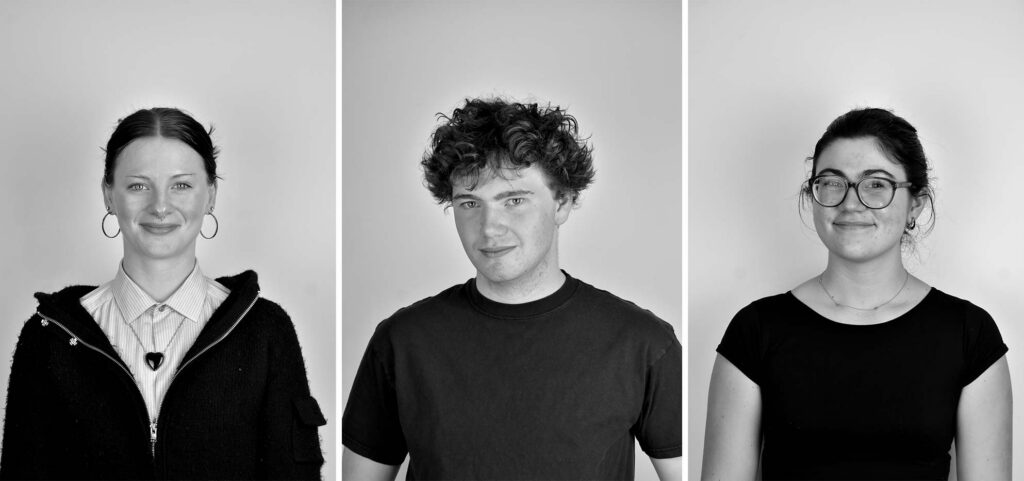
ARCH1’s project, “Deteriorating Traces,” was submitted by B.S. Arch ’26 students Lilijana Gregov, Rowan Freeman, and Julianne Cucos, and was one of only three entries recognized from the U.S. among the winners and short-listed proposals for the global competition.
Archcontest serves as a platform that links creatives from around the world with partners and stakeholders in need of high-quality project executions, such as building rehabilitation, urban redesign, or district transformation. Competitions offer participants an opportunity to develop skills, learn, and create a significant impact on society.
Founded in 2024, ARCH1 is the first architecture project team at the University of Michigan. The team’s focus is on producing unified design proposals for researched architectural project competitions, while also enhancing students’ portfolios, team-building abilities, and practical architectural skills.
“We try to bake in a lot of community into ARCH1, which makes internal project critiques flow a lot smoother,” said Elliot Lavigne, B.S. Arch’26, ARCH1’s principal director.
Working in teams of three, ARCH1 submitted nine different proposals for the competition, with each small group project reviewed and informed by the larger team.
“As an architect, you will always be presented with projects that you aren’t sure how to represent at first. ARCH1 offers Taubman students a connection to the real world,” said Gregov, ARCH1’s creative director. “It also offers more community between undergrads at different levels. There’s something to learn for everyone working with people in different stages of architecture.”
Read more about the third-place project below.
Deteriorating Traces
Students: Lilijana Gregov, Rowan Freeman, Julianne Cucos
“This installation is a physical experiment in indeterminacy. Stud walls, clad in thin plywood and uniformly painted red, create spatial conditions that seem stable but are not. Visitors enter as observers and, through each movement of a wall, unwittingly alter the space. Any interaction can trigger panels to tip, joints to fail, or plywood to splinter. These events do not follow a set order; they occur as actions accumulate, eventually collapsing the system from within. Every time a wall moves, the room takes on a new, unique configuration that will never repeat. Each change permanently alters the form, creating a fresh set of unknown possibilities for the next visitor. This installation ends when only four walls remain, compressed into a space that can no longer be entered, surrounded by traces of its previous states.
The project shows how user actions lead to irreversible changes in space. As the structure shifts, sustains damage, and nears its final closed state, each choice made leaves a physical record. The surrounding pavilion supports this, containing the experiment and framing its ongoing transformation. Rather than appearing as debris in the open landscape, the installation is presented as a controlled test, an environment meant to evolve, fail, and eventually conclude.”
— Story by Christina Barber