Faculty and students showcase research at ACADIA 2026
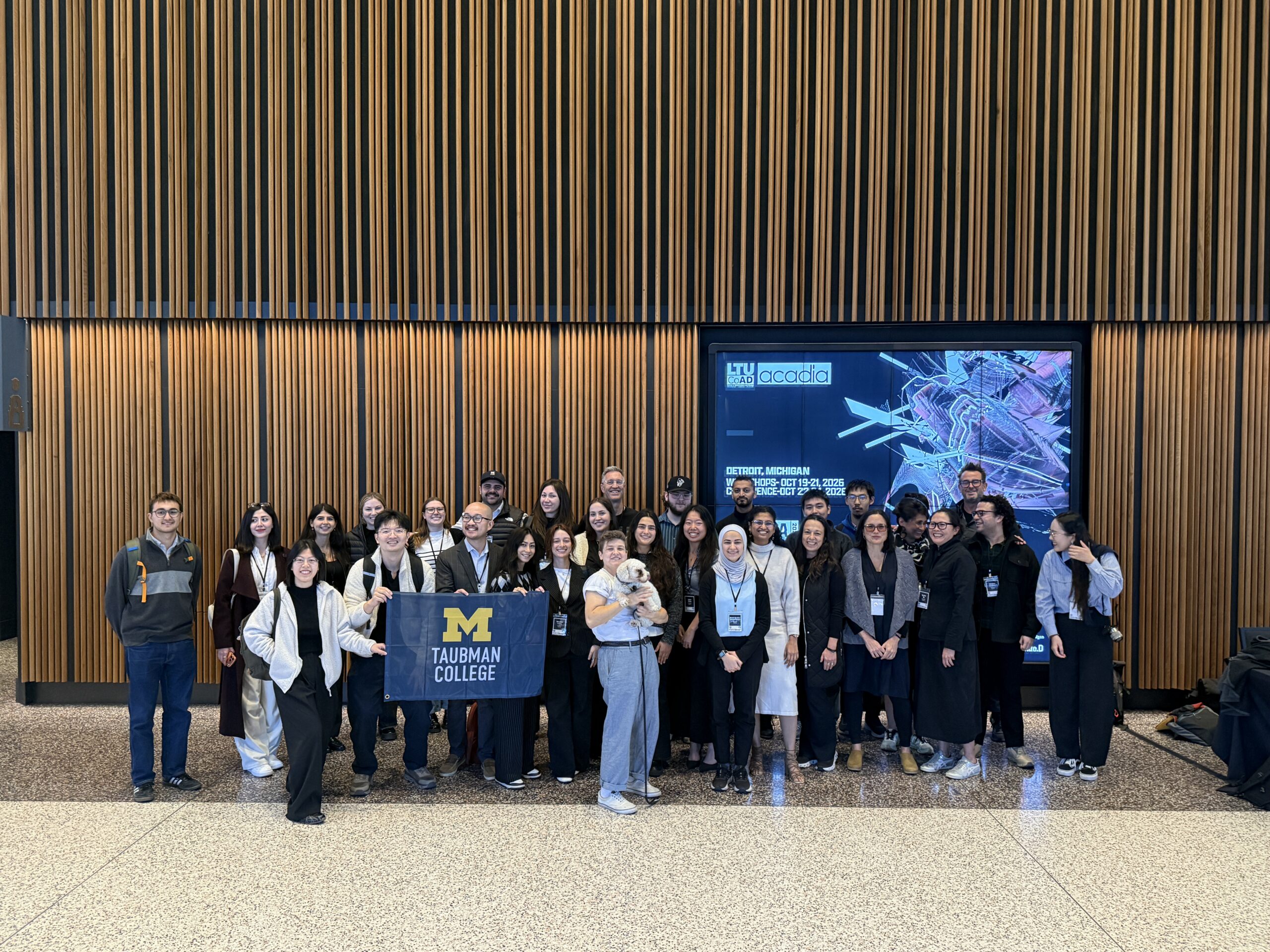
Taubman College of Architecture and Urban Planning faculty participated in multiple events at the 2026 Association for Computer-Aided Design in Architecture (ACADIA) Conference, hosted by Lawrence Technological University’s College of Architecture and Design in nearby Southfield, Michigan, last month. This year’s theme, Humanism Recorded: Reframing Computation and Making through Embodiment and Culture, brought together an international community of architects, designers, and researchers to explore emerging approaches to computational design, material innovation, fabrication, and human experience.
Upali Nanda, professor of practice in architecture at Taubman College, moderated the keynote panel “Project WHY,” leading a discussion about how the built environment shapes our experiences and evokes feelings of belonging and creativity. The project brings together designers and researchers to investigate links between our spaces and neurobiological, psychological, and behavioral outcomes.
The Taubman College community was also represented in several conference sessions.
Qingru Yang, M.S. ’26, Po-Chun Chou, and Sean Alquist, associate professor of architecture, presented a preview of their research project “Curl-to-Grip: Encoding Grip Performance in CNC Knitted Textiles,” exploring how computationally designed knitted structures can encode functional performance into textile materials.
M.Arch ’26 alumni Felix Lam and Andrew Masternak, along with faculty Wes McGee and Tsz Yan Ng, presented “Cured Creases,” a project investigating alternative approaches to concrete formwork using folded paper and cardboard. Through physical prototyping, material testing, and digital simulations, the team developed lightweight, recyclable, and customizable paper formwork to reduce construction waste, labor, and the environmental impact of concrete.
Ph.D. candidate Alireza Fazel and professors McGee and Peter von Bülow presented “Stress-Guided Overprinting: Robotic 3D Printing for Reinforced Thin Shells,” a workflow for improving the structural performance of lightweight thermoplastic shells produced with large-scale fused-granular 3D printing.
McGee also took part in a book forum for Plastic Futures in Architecture: From Recycled Synthetic to Bio-Based Polymers, along with fellow contributors and architecture professors Geoffrey Thün and Kathy Velikov, FAIA.
Ph.D. Candidate Abdallah Kamhaw and Mania Aghaei Meibodi, assistant professor of architecture, along with Jesse Capecelatro, associate professor of mechanical and aerospace engineering, presented “From Tile to Filament: A Cohesive Lamination Method for Scaffold-Free 3D Concrete Printed Vaults.”
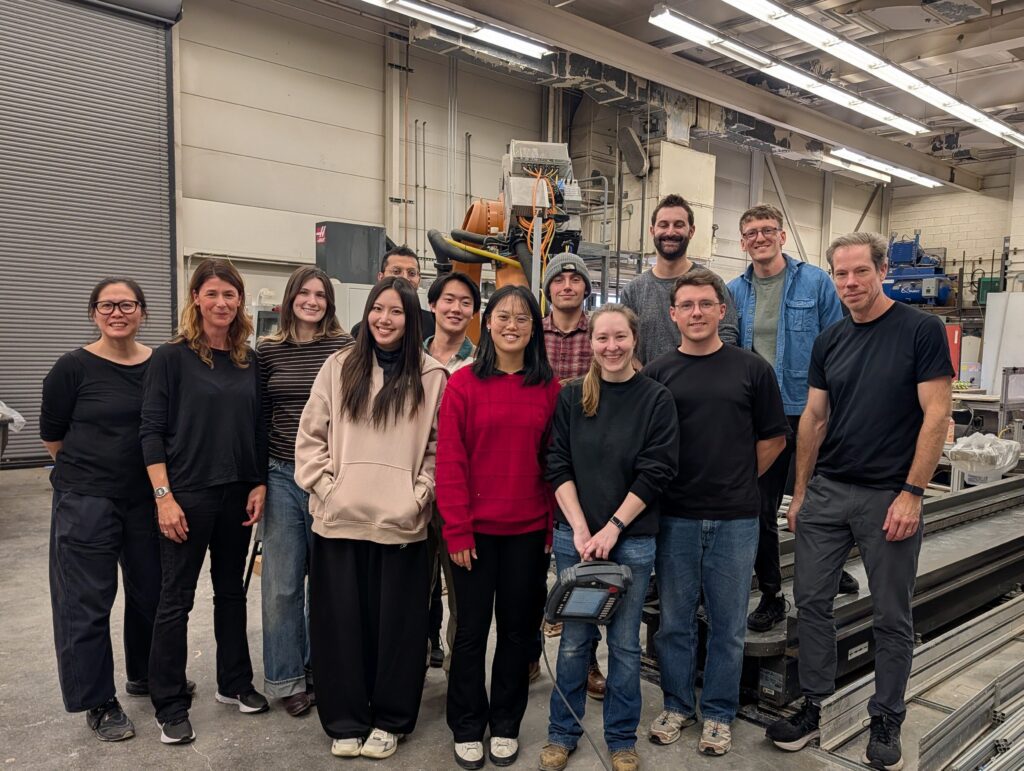
Closer to home, Taubman College’s Fabrication and Robotics Laboratory (FABLab) hosted Growing Facades: Large Format Robotic Clay Printing for Bio-Integrated Architecture in the days preceding the conference. This workshop, led in part by FABLab manager Rachel Henry, M.Arch ’18, investigated robotic clay printing and the development of bioreceptive ceramic components designed to support biological growth.
Participants applied living algae to the ceramic modules to test how surface geometry, texture, and moisture can influence bioreceptivity. Using robotic fabrication and experimental clay composites, participants explored how architectural surfaces might integrate biological systems to create more ecologically responsive building technologies. The resulting prototypes were then presented during the conference.