Objects of Care
Professor Catie Newell shares personal work on grief and connection with northern Michigan communities.
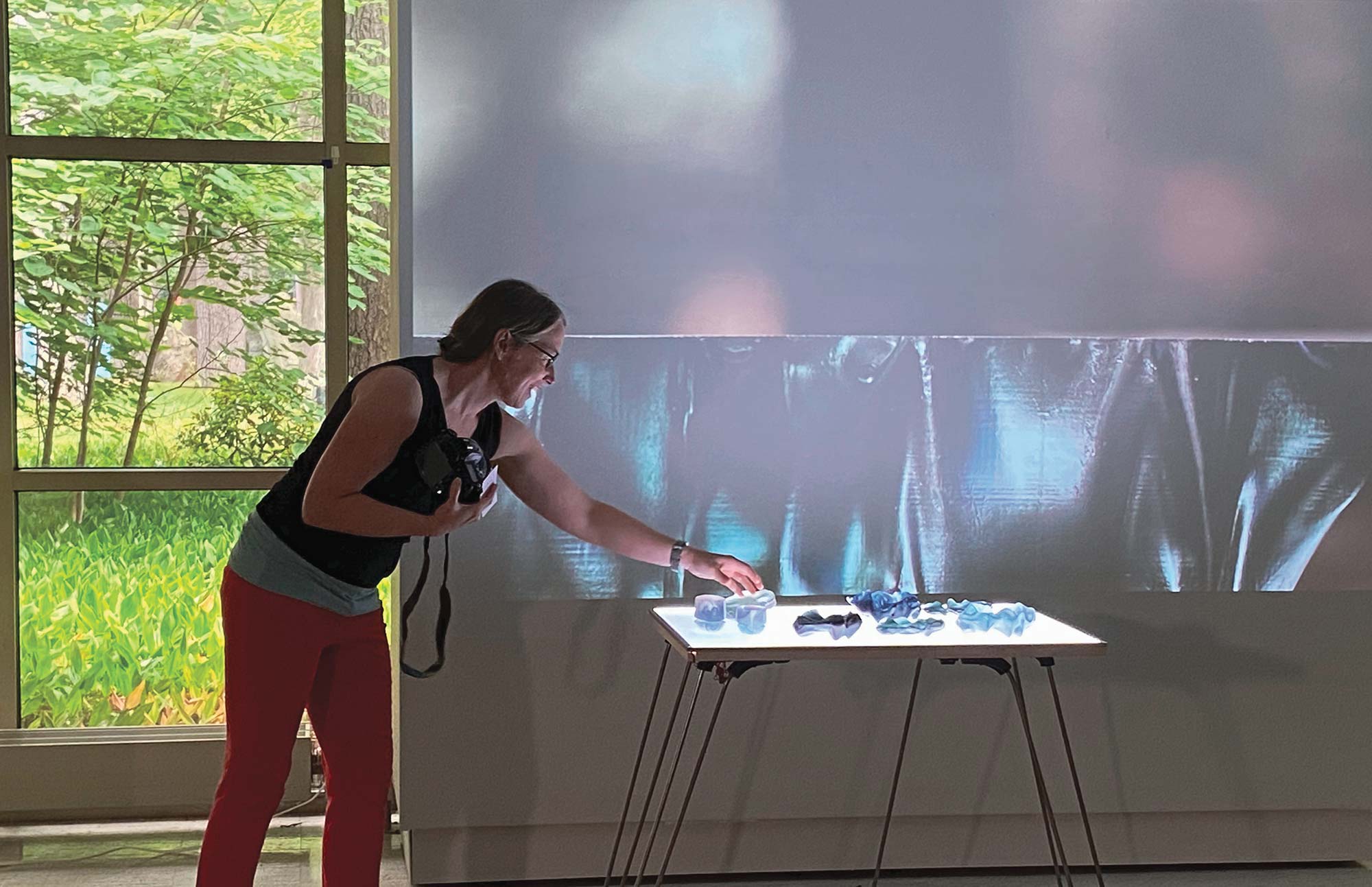
Kristel Ambrosius watched from the back of an exhibit room as her daughters Sadie and Tessa held wavy glass objects and talked with Catie Newell, an architect, professor, and artist visiting their northwestern Michigan hometown last summer.
Hearing about Newell’s vision and practice was a unique experience for each of them, as was touching the “Depth objects” she displayed at the Dennos Museum in Traverse City. The girls could see their hands through the glass. Some people held the objects to their chests.
“They’re somewhere between stuffed animals and worry stones, and are objects that I made as a grief companion after my father’s passing,” says Newell, professor of architecture at Taubman College.
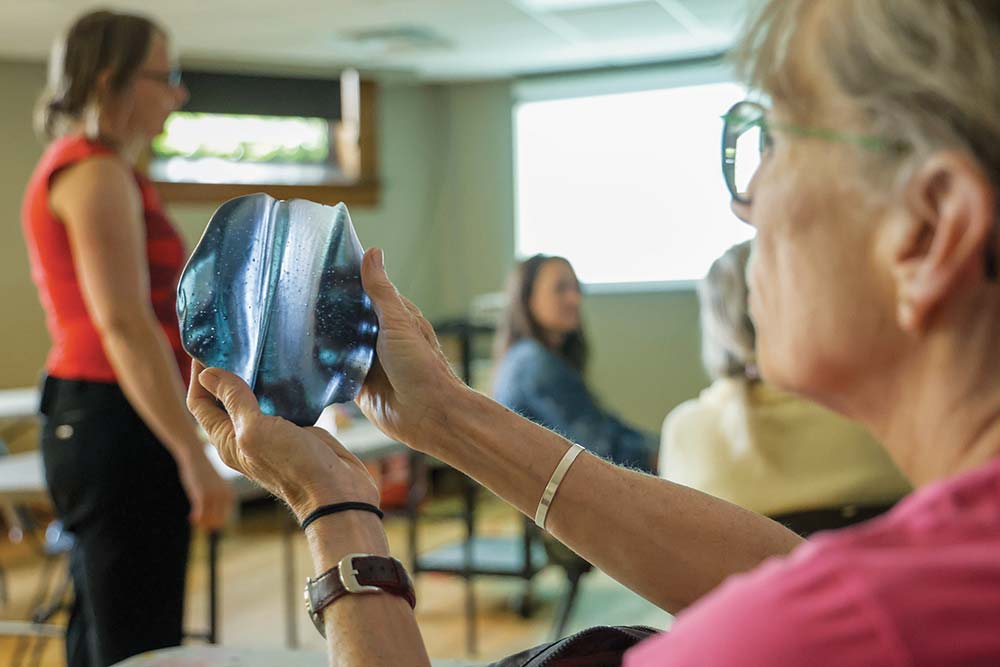
The pieces are part of a larger collection of Newell’s work exhibited in northern Michigan over the summer, including functional and conceptual objects and the photography series “GoodBye.” “Objects for Passing: Art for Grief, Care and Life Transitions” featured artist talks and hands-on workshops held in Traverse City and Petoskey.
Newell’s visits were part of the U-M Arts Initiative’s Faculty Arts Ambassador Program, which sends faculty artists into communities across Michigan to share their work with the public. The experience gave attendees a glimpse into her practice of exploring light, perception, and the emotional weight given to objects and environments.
Feeling the Weight
The Depth objects are kiln-cast glass forms that use digital and hand processes to coordinate light and color effects with form, weight, and texture. Newell 3D-prints the base forms, then uses kiln-casting and polishing techniques to adjust surface and light qualities. Each object is unique, with thick and thin, dark and light, textured, bubbled, and smooth areas in shades of gray, green, and blue. “They’re meant to be felt on the hand, but there’s a little bit of preciousness left to them. So they are held carefully, placed carefully, and passed carefully,” Newell says.
Sadie, 14, held all of the Depth objects. Her favorite pieces contained many transitions between sharpness and softness.
“They were a lot heavier than I expected,” she says. “The glass was made into something that you can touch and feel and has all this substance and weight.”
The family came to give Sadie, a painter, a chance to talk with another artist and join the workshop, but also to learn about the big topic of grief. “It’s nice to see that the artists are taking on some of these areas that maybe we find hard to give words to,” Ambrosius says.
Gentle Prompts from a Death Doula
After her father died in 2020, Newell trained as a death doula to help others advocate for what they wanted in their lives when they are dying. The exhibit grew out of these experiences.
“There are so many conversations that are just never had. And I think that’s pretty common,” she says. “I have been drawn to figure out how to … create some things and methods that allow people to feel comfortable to start having these conversations.”
She created hand-stamped cards printed with topics and prompts to help carers and others experiencing loss or grief start conversations about passing. Categories include Space and Place, Boundaries and Refusals, Expression and Legacy, The Body, Spiritual/Cosmological, and more.
Workshop participants were invited to select as many cards as they wanted. Sadie chose “Release” among hers. It included the prompt: “Is there something you want to make or unmake in order to release it?”
“I interpreted that one as release from maybe constantly thinking or worrying about it and just acknowledging that it exists,” Sadie said.
Newell designed the cards to help participants quietly think through questions while sharing the energy of the group setting. In closing, she asked them to take what they learned from the cards and use it to write a letter to themselves or a friend or leave a voice memo they could recall later.
Sharing Meaningful Moments
For Newell, the workshop experience was intimate and invigorating. Attendees ranged from teens to college students to retirees.
“I have so many little words and phrases and thoughts that have come from other people that I (wrote) down …. I’d say the best moments have been talking one-on-one with people,” she says. “Each person provided me with a conversation that was unexpected, but super empowering to the work.”
Newell also designed a set of functional objects including cups, wash basins, and plates. The plates have hard swirls of glass with sharp points that signal they are no longer suitable for food when a loved one can no longer eat. The cups are made to hold a single ounce of water on one side and a half ounce on the other: all her father could drink as he made the transition from life to death.
“The ‘Objects for Passing’ was something that allowed me to have sort of a literal place to put grieving and worry and to imagine passing it to others when they were feeling the same sort of thing,” Newell says. “There are these sort of beautiful, meaningful moments of caring for others. And these are a few pieces that came from trying to unpack and understand moments in witnessing someone’s transition of life to death.”
— Greta Guest