


Urban Technology
Research Cluster
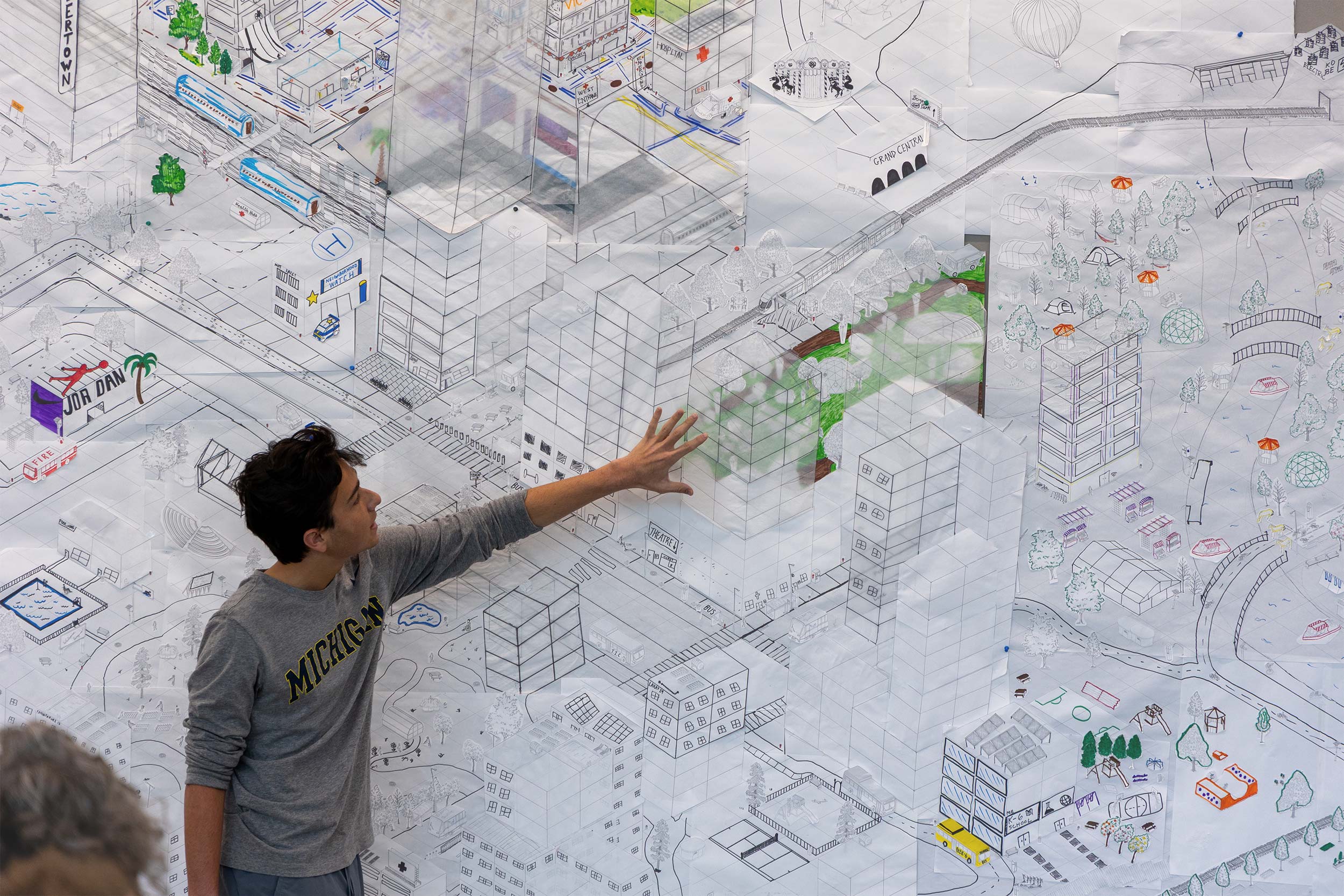
Urban Technology focuses on the intersection of technology, design and cities. The cluster applies digital tools, data analytics, and human-centered design to improve urban functionality, sustainability, and quality of life. Research and projects address challenges like transportation, housing, and resource management to create urban environments that are more sustainable, just, and humane.
How to Engage
For Collaborators and Partners
Urban Technology faculty and teams partner with other designers, scholars, and technologists — as well as civic organizations, municipal agencies, nonprofits, and private sector teams to co-design and test urban interventions. Whether you’re looking to make sense of local data, connect a community challenge to research expertise, or scale a promising pilot, reach out to individual faculty or their lab groups to explore a collaboration.
For Prospective Students and Research Assistants
Urban Technology at Taubman College trains the next generation of designers, planners, and technologists working at the intersection of cities and data. Follow our Substack to stay current on projects, opportunities, and the evolving shape of the program. Check out what’s happening with faculty research, as well as their lab groups. Get in touch and share your interests with an individual faculty member if you’d like to work on research projects.
For Funders
Sponsor support directly enables the research, field work, and public-facing outputs that accelerate Urban Technology impacts for cities and communities. Funds go toward student research assistantships, field research and implementation, data analysis, prototyping, and publications — including demos, policy briefs, guides, and peer-reviewed work. We welcome conversations with foundations, public agencies, and mission-aligned donors.
Research Scope & Societal Relevance
Urban Technology addresses critical, interconnected issues:
- Designing cities as socio-technical systems shaped by both infrastructure and everyday life.
- Building civic technologies that improve access, accountability, and public participation.
- Exploring new approaches to community engagement that ensure data-driven tools reflect lived experience.
- Confronting questions of data governance, ownership, and ethical use in urban contexts.
- Integrating design, analytics, and engineering to rethink infrastructure and the built environment.
Advancing sustainability and resilience while addressing equity and long-term social impact.
Faculty





Constellations of Projects & Methodologies
Urban Technology is defined by projects and outputs that share methodological threads while adapting to design and urban infrastructure contexts and community needs:
A partnership with the Michigan Association of Planning (MAP) that began in early 2023 to begin developing the interactive map as part of a coordinated effort through the National Zoning Atlas. The Michigan team recently launched a pilot zoning atlas of the Grand Rapids area — the first step in a statewide zoning atlas.
Behind the Cloud: How Datacenters Shape Water, Energy, and Communities
The rapid proliferation of data centers imposes significant and often poorly understood demands on local energy and water systems. Loudoun County, Virginia, home to the world’s largest concentration of data centers, has become a focal point for these challenges, as communities and utilities navigate infrastructure strain, rising costs, and environmental impacts. This project aims to clarify both the challenges and opportunities of data center expansion.
A New Model for Identifying Abandoned Urban Properties
Taubman College researcher Xiaofan Liang and colleagues created an innovative new model to identify neglected and abandoned urban properties, which could ultimately help city officials protect and support growth within their communities.
Transportation Research Record
Analyzing the relationship between Atlanta’s international airport and local biking and pedestrian infrastructure in a paper recently published in Transportation Research Record.
Growing Local Roots project with Michigan Economic Development Corporation
Students engaged in an innovative collaboration with Let’s Grow Michigan and the Michigan Economic Development Corp. to unveil projects that featured service concepts to ease and enhance the “onboarding experience” of new Michiganders.
A set of “micro briefings” that explore future potential areas of research in mobility justice and sketches out a dozen broad questions where mobility justice implicates urban design & technology.
On Mobility: The Five Sense of Autonomous Vehicles
In this essay, Bryan Boyer explores how glossy autonomous vehicle concept videos mask the deeper sensory and social transformations AVs could bring to urban life. By examining mobility through the five senses, Boyer reframes AVs as a cultural and design challenge.
CSforDetroit is a multi-year initiative, developed by a group of diverse stakeholders across the city of Detroit and beyond. This initiative aims to equip K-12 students with a culturally responsive computer science education for tech-driven futures that lead to success in college, career, and life.
To stay up to date with the cluster or if you’re interested in urban technology, the future of cities, design, design education or some swirl of all of those, subscribe to the Urban Technology newsletter through substack!
Longer-Term Goals & Future Objectives
- Develop novel design methods for creation of urban technologies
- Collaborating with research fellows and interdisciplinary partners to expand and advance ongoing research efforts.
- Publishing peer-reviewed research and presenting findings at academic and professional conferences.
Affiliated Labs
 Link copied