


Emma Vitet
Bachelor of Science in Urban Technology
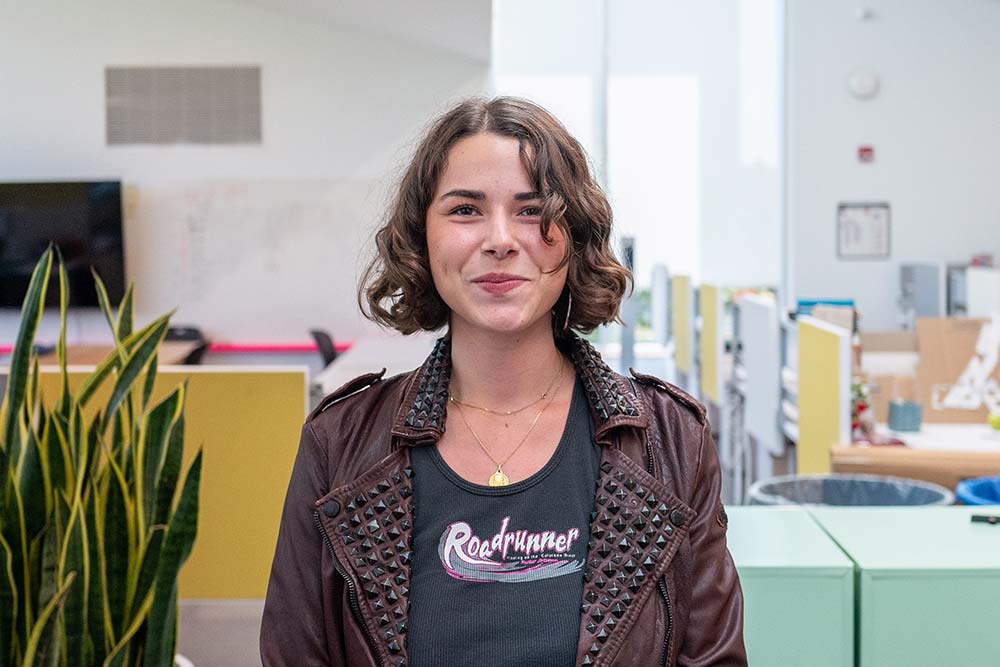
A dual French-American citizen, Emma Vitet, Urban Tech ’26, grew up in Frankfurt, Germany, where her exposure to a walkable neighborhood and different cultures developed into an interest in urban spaces. In the summer of 2025, she interned with Cities Reimagined, a human-centered design firm focused on livable, sustainable, and equitable cities.
Why did you choose the Urban Technology program at Taubman College?
Originally, I wanted to study urban planning, but then I was just researching and browsing schools in the U.S. and I found urban tech, and that seemed a lot better aligned with what my personal goals were for my career.
Can you explain a little bit about your internship?
I interned with Cities Reimagined, where I did service design. I worked closely with the Cities team and their clients, which involved desk research, interviewing clients, and other miscellaneous tasks. I also led a guided bike tour, the Jane’s Walk (Named after urban activist and writer Jane Jacobs, Jane’s Walks are neighborhood walking/biking tours that takes place in hundreds of cities each year.).
What is service design?
With Cities Reimagined, the goal is to identify urban problems or help cities or private partners diagnose them. After that, we help them think through the problem, come up with a solution, and implement it.
How did urban technology apply to your internship?
We had a service design studio, so that helped with aspects like laying out a journey map, laying out a service blueprint, and knowing how to interview. On the more technical side, using tools like Figma, Felt, and Air Table have shaped my overall workflow. Being in a school of design helps with thinking through problems in a very specific way. I would also emphasize thinking about the end user.
What was a highlight of your internship?
The Jane’s Walk was one of the more fun experiences. Guiding people through a city is very different from what you think it is. Being able to answer questions, point out things people might not notice, and bike through a city that isn’t necessarily bikeable, all these things were super valuable to me and I would love to do it again.
What connections do you see between the Cities Reimagined design process and the urban technology design process?
It is much closer related than I thought it would be. I think that there’s a lot of anxiety around urban technology as a concept in school relating to actual work being done and being able to find a job, but I have found that it was very close and the things that I needed to know I had already learned in class. It was more like a way of thinking and a way of showing up in this work that I do with Cities that I had already learned for the past three years. So working at Cities and then bringing that back to UT, I think it has shown me and relieved much of that anxiety, because I realized “Oh, these are actual important skills, whether they be hard skills or soft skills.”
How has this internship helped your future career goals?
It’s helped me a lot. One of my goals is to move to Detroit after graduating, so it was very important to me to make connections and start putting down roots there.
What is the role of a service designer in the future of Detroit?
Listening to people’s needs, concerns, and ideas is something that keeps coming back. Especially in a city like Detroit, that’s something that has fallen short a lot of times and that’s why we deal with a lot of issues today. When you come into a new community, you need to level all of your assumptions and biases.
What would be your ideal project in this field?
Consolidating data sets and making them accessible to the public, like housing data or unemployment data, anything to make it more understandable for residents, but also all of the nonprofits in Detroit. Many nonprofits are working toward the same thing, but they’re not sharing resources. I would have everyone sit at the same table and be like, “I’m using this data and you’re using that data, let’s figure it out.”
Interview by Joshua Nicholson
