Taubman College Announces 2026 Wallenberg Studio Awards
Taubman College recognized seven undergraduate students with 2026 Wallenberg Studio Awards during a May 1 symposium. The winners were B.S. Arch ’26 students Constanza Capriles, Fatema Almoamen, Emma High, Misk Aldulaimy, John Watha, Gulshat Roziali, and Taylor Horsfall.
Each year, senior undergraduate students in the Taubman College B.S. in Architecture program complete the Wallenberg studio, named after renowned alumnus Raoul Wallenberg. As the final studio required for completion of their degree, students build on their past skills and experiences to explore the transformative power of architecture through a focus on broad humanitarian concerns.
At the end of the semester, the top students are awarded the Wallenberg Studio Award. Funded by the Raoul Wallenberg Endowment, awards are offered as a stipend for international travel to a country of the student’s choosing. Building on Wallenberg’s legacy, the stipend encourages students to engage with the people, architecture, and culture of the country they visit and return with a broadened understanding of the world. This year, there was a winner awarded for each studio, as well as eight honorable mentions.
The guest jury consisted of three visiting architects from across the country: Rhania Ghosn, associate professor of architecture and urbanism at the Massachusetts Institute of Technology; Jerome Haferd, assistant professor of architecture at City College of New York; and José Ibarra, assistant professor of architecture at Penn State University.
More details about the winners and their projects, with an excerpt from the guest jury’s decision, are below.
Constanza Capriles, “Tierra de Gracia: Thresholds”
Studio: Imagineries for Patchy Ecologies
Instructor: Zain AbuSeir
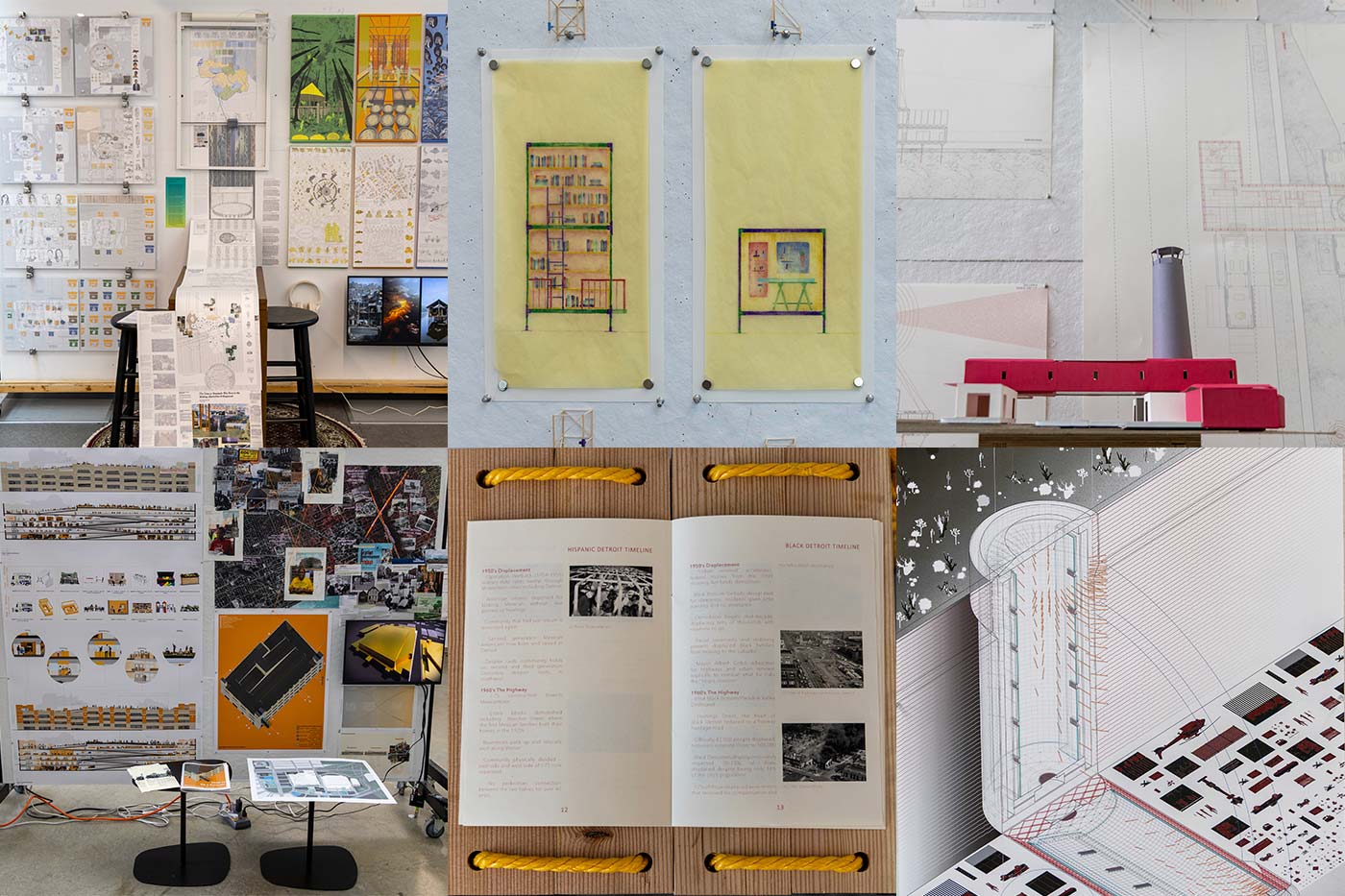
“Speaking personally as a Venezuelan, one of the things that struck me most was the thoughtfulness of remapping the country away from its 25 states and federal dependencies into 13 territories grounded in Indigenous forms of knowledge. These territories become ways of gathering, listening, and rebuilding collective agency. The representation and exhibition setup were especially compelling because they performed the project’s argument: dense, layered, beautiful, and precise, while still carrying emotional and public clarity.”
Fatema Almoamen, “reFramed: A Series of Do-It-Yourself Reactivating Assemblies”
Studio: Salvaging: Material and Memory after Demolition
Instructor: Tess Clancy
“Addressing the widespread vacancies and demolition that have reshaped block life in Detroit through imposed decisions about form, density, and value, the project took a powerful position: to acknowledge the house that stood before, and through salvage and reassembly, to invite connections amongst neighbors back into the block. We were especially struck by the way it embraced Detroit’s living do-it-yourself heritage, framing building assembly – and the steel joint itself – as a tactical and social act of reactivation.”
Emma High, “Ambler Medevac + Trauma Clinic”
Studio: THE AMBLER ROAD – Cosmopolitics of Arctic Territory
Instructor: Nitzan Farfel
“This project distinguished itself through the clarity, conviction, and humanity of its architectural response. In a studio attentive to the many lives shaped by the road, it focused with particular force on those who labor on the land and construct it, asking who bears the risks of infrastructure and who remains unseen within its promised benefits. In a permafrost landscape located hundreds of miles from the nearest hospital, the project identified a profound humanitarian condition: emergency care cannot be assumed, and public health is inseparable from planetary, territorial, and infrastructural realities.”
Misk Aldulaimy, “Land as Memory”
Studio: Celestial Artifice + Subterranean Clouds
Instructors: Dawn Gilpin and Gina Reichert
John Watha, “Beyond Babel”
Studio: Swamp Logics
Instructor: Neal Robinson
Gulshat Roziali and Taylor Horsfall, “End of the American Dream”
Studio: Mavericks, the Multitude, and the Mesa
Instructor: Geoffrey Thün
“By recasting the haunting remnants of decommissioned missile silos into a network of cultural and territorial interventions, it thickened the history of the desert as a site shaped by Cold War securitization and contemporary regimes of surveillance and migration, while redirecting that inherited infrastructure—and the cultural legacy of land art—toward refuge. What made the project especially powerful in the context of the Wallenberg legacy was its understanding of refuge as an architectural obligation.”
Honorable mentions included Alexandra Mercier, B.S. Arch ’26; Noorhan Moustafa, B.S. Arch ’26; Anthony Miller, B.S. Arch ’26; Eduardo Cardenas Denova, B.S. Arch ’26; Madeline Tay, B.S. Arch ’26; Audrey Bellak, B.S. Arch ’26; Mariam Reyes-Toidze, B.S. Arch ’26; Anna DeYoung, B.S. Arch ’26; and Watson Baek, B.S. Arch ’26.