Taubman College Presents 2026 Master of Architecture Thesis Awards
Taubman College recognized nine graduating students in the Master of Architecture program for their final thesis proposals this spring. In addition to an overall award and student voice award, awards were presented in various categories, including representation/new media, history and theory, storytelling, social impact, and more.
A list of finalists and winners, along with an excerpt from each winning thesis, is below.
Burton L. Kampner Award for Best Thesis
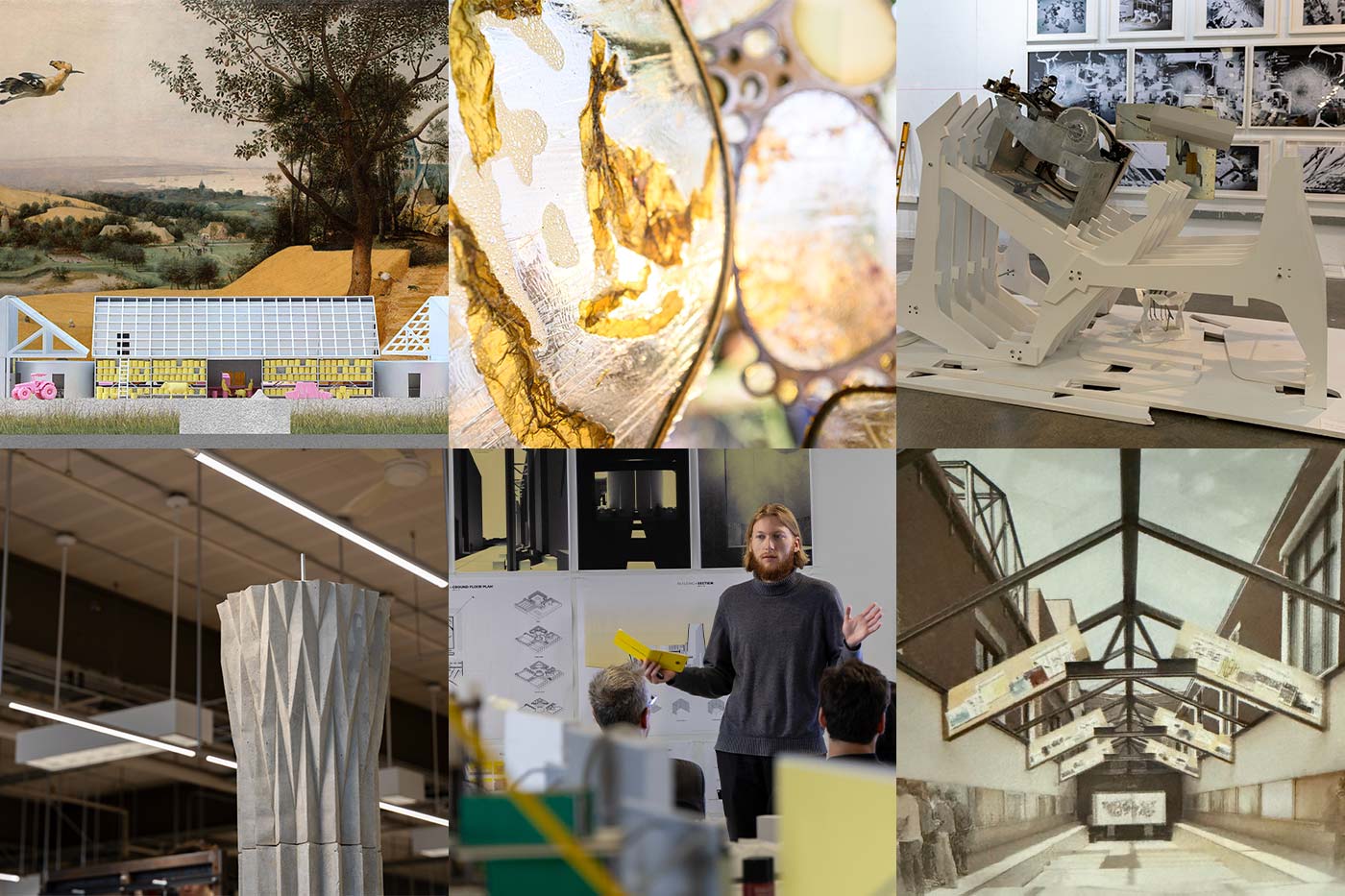
Winner: Brianna Manzor, “Edible Commons: Restaurant as Microcosm of Worlds”
(Studio: Microcosm Thesis: Architecture as Microcosm of Issues, John McMurrough)
“Formally porous and programmatically unresolved. Boundaries are collapsed between domestic and productive space. The form becomes a highway for flora and fauna. Migratory birds, livestock, native grasses, minerals, and microbes are a short list of users. Systems are intentionally inefficient, slowing processes of production and consumption to reorient users toward the land. Ingredients are locally foraged and hunted. Slaughter becomes political theater and composting becomes a public ritual.”
2025-2026 Thesis Class Choice Award
Winner: Jordan Lindberg, “A Kitchen that Grows: Care and Cultivation in the Home”
(Studio: Bio-logics: Experimental Practices in Architecture’s Biological Turn, Kathy Velikov)
“This thesis envisions a kitchen where growth, care, and cooking merge. Counters, prep areas, and shared spaces host multiple processes at once, allowing humans and algae to exist in rhythm. Daily acts of misting, observation, and tending form occupiable spaces that hold moisture, while vessels catch light and air. The home becomes an ongoing network of care between people and the microbes around them.”
Representation/New Media
Winner: Roman Marra, “Peripheral Obsolescence”
(Studio: Iridescent Irises, Perry Kulper)
“The device carries diverse material, ranging from stepping motors to rotating armatures, each which was previously fixed to certain axes and protocol. The nature of the thesis is to understand that while the pieces are being retrained to serve a role of production, their previous lives as tenets to the visual field machine are not forgotten. The pieces hesitate, they are relying on memory and their prior routines to be agents of their new work. The pieces become contingent on memory and the past to produce the exercises of its new afterlife.”
Materials, Tectonics, & Construction
Winners: Felix Lam and Andrew Masternak, “Cured Creases”
(Studio: Concrete Labor_Circularity, Tsz Yan Ng)
“Inspired by Japanese origami, and the research of J. Choma and E. Lloret-Fritschi, our project seeks to perfect a system of concrete formworks by simply using folded paper membranes and corrugated cardboard supports to cast column components. The interest in using recyclable paper products as the basis for our formwork system is both pragmatic and conceptual.”
History & Theory
Winner: Brianna Manzor, “Edible Commons: Restaurant as Microcosm of Worlds”
(Studio: Microcosm Thesis: Architecture as Microcosm of Issues, John McMurrough)
Sustainability/Environmental Stewardship
Winner: Jordan Lindberg, “A Kitchen that Grows: Care and Cultivation in the Home”
(Studio: Bio-logics: Experimental Practices in Architecture’s Biological Turn, Kathy Velikov)
Storytelling
Winner: Jacob Brookhouse, “Renewal Power Station: Energy as Microcosm of Heliolatry”
(Studio: Microcosm Thesis: Architecture as Microcosm of Issues, John McMurrough)
“This power station, like others, provides utility; it powers. It converts natural sources of energy into electricity to be used by those connected to it across the grid. The building itself embraces this utilitarian nature. It provides shade, warmth, respite. It has places to sit, to look, to listen. It has bathrooms. These basic practicalities become venerated, lifted to a state that necessitates reflection, urges reverence. The power station elevates the most basic of human needs. It renews.”
Social Impact
Winner: Jack Smith, “Detroit Center for Architecture and Repair (D/CAR)”
(Studio: Architecture School*, Sharon Haar)
“The project repositions architectural education around adaptive reuse, building repair, land regeneration, and civic stewardship. D/CAR teaches students through direct engagement with real conditions of vacancy, deferred maintenance, environmental damage, and neighborhood change while fostering a creative environment for students to explore their own interests.”
Thesis faculty for 2025-2026 were Adam Fure, Sharon Haar, Irene Hwang, Perry Kulper, John McMorrough, Tsz Yan Ng, and Kathy Velikov. This year’s Thesis reviews took place on April 29 and 30, where students presented their work to a group of guest critics:
- Ila Berman, University of Virginia
- Joseph Choma, Florida Atlantic University
- Karl Daubman, Lawrence Technological University
- Sarah Dunn, University of Illinois-Chicago
- Joyce Hwang, University of Buffalo
- Max Kuo, University of California-Los Angeles
- Amelyn Ng, Columbia University
- Christopher Romano, University of Buffalo
- Georgeen Theodore, New Jersey Institute of Technology
- Gretchen Wilkins, Lawrence Technological University
- Jason Young, University of Tennessee