Three Taubman College teams win U-M AI Awards
From smarter concrete printing to clearer data-center planning, Taubman College of Architecture and Urban Planning researchers are putting AI to work on real-world challenges across the built environment, earning university-wide recognition in the process.
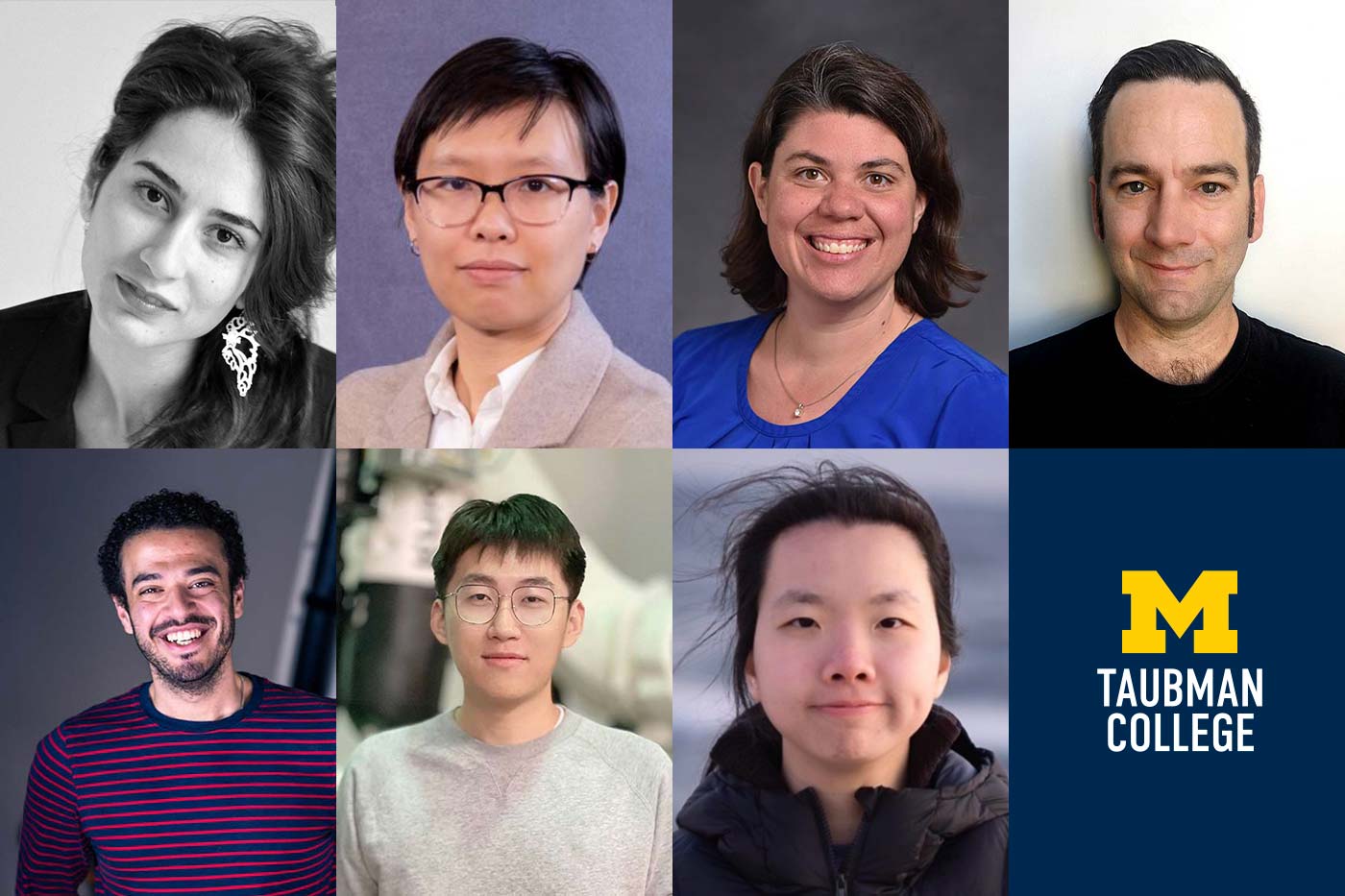
Three teams featuring professors and students from Taubman College were awarded University of Michigan Empowering Research Through AI awards. The awards were presented by the AI Institutes at Michigan and recognize the teams’ use of artificial intelligence to advance knowledge or practice in research fields.
To be considered, teams had to demonstrate that AI was central to their research, not just a supporting tool. AI methods ranged from established approaches, such as machine learning and computer vision, to generative and multimodal AI. The selection criteria also included the responsible use of AI, project impact, and clarity.
A total of 86 projects received first, second, and third-place awards out of 180 submissions across the university. The winning Taubman College teams and a brief description of their projects are listed below.
AI-Enabled Multimodal Learning and Decision Making for Robotic 3D Concrete Printing: Linking Process Pre-Planning with In-Line and Post-Process Data Collection to Construct
Yuxin Lin, Ph.D. student; Mania Aghaei Meibodi, associate professor of architecture; Kira Barton, professor of mechanical engineering and robotics at U-M College of Engineering
This project develops a data-driven framework that integrates multimodal sensing, machine learning, and predictive decision-making to improve the reliability of 3D concrete printing. By linking process planning with in-line and post-process data, it replaces trial-and-error fabrication with measurable, model-informed workflows.
Generative AI Design Model to Enable Scaffolding-Free Robotic 3D Concrete Printing of Vaulted Structures
Abdallah Kamhawi, Ph.D. student; Mania Aghaei Meibodi, associate professor of architecture; Jesse Capecelatro, associate professor of mechanical engineering at U-M College of Engineering
This project is part of Aghaei Meibodi’s ongoing research into 3D concrete printing. The project requires tools and computational models to allow architects and engineers to design high-performing, printable building components and robust robotic 3D printing systems capable of fabricating complex geometries without extensive trial-and-error. Read more about this work in the Taubman College Newsroom.
Governing AI’s Footprint: Making Data Centers and Zoning Legible
Xiaofan Liang, assistant professor of urban and regional planning; Zhixuan Qi, Ph.D. student; Matthew Wizinsky, associate professor of practice in urban technology; Sarah Mills, associate professor of practice in urban and regional planning.
This project is an ongoing research initiative that originated from a MIDAS/Microsoft-funded project (2025–2026) to develop AI-driven methods for representing and extracting zoning regulations related to data centers and renewable energy facilities. It has since expanded (2025-2026) to include the Data Center Complexity Visualization Project, which informs urban planners about the complex implications of data centers through a white paper and design visualizations.