Urban Technology students work with GM and partners to envision human-centered autonomous mobility
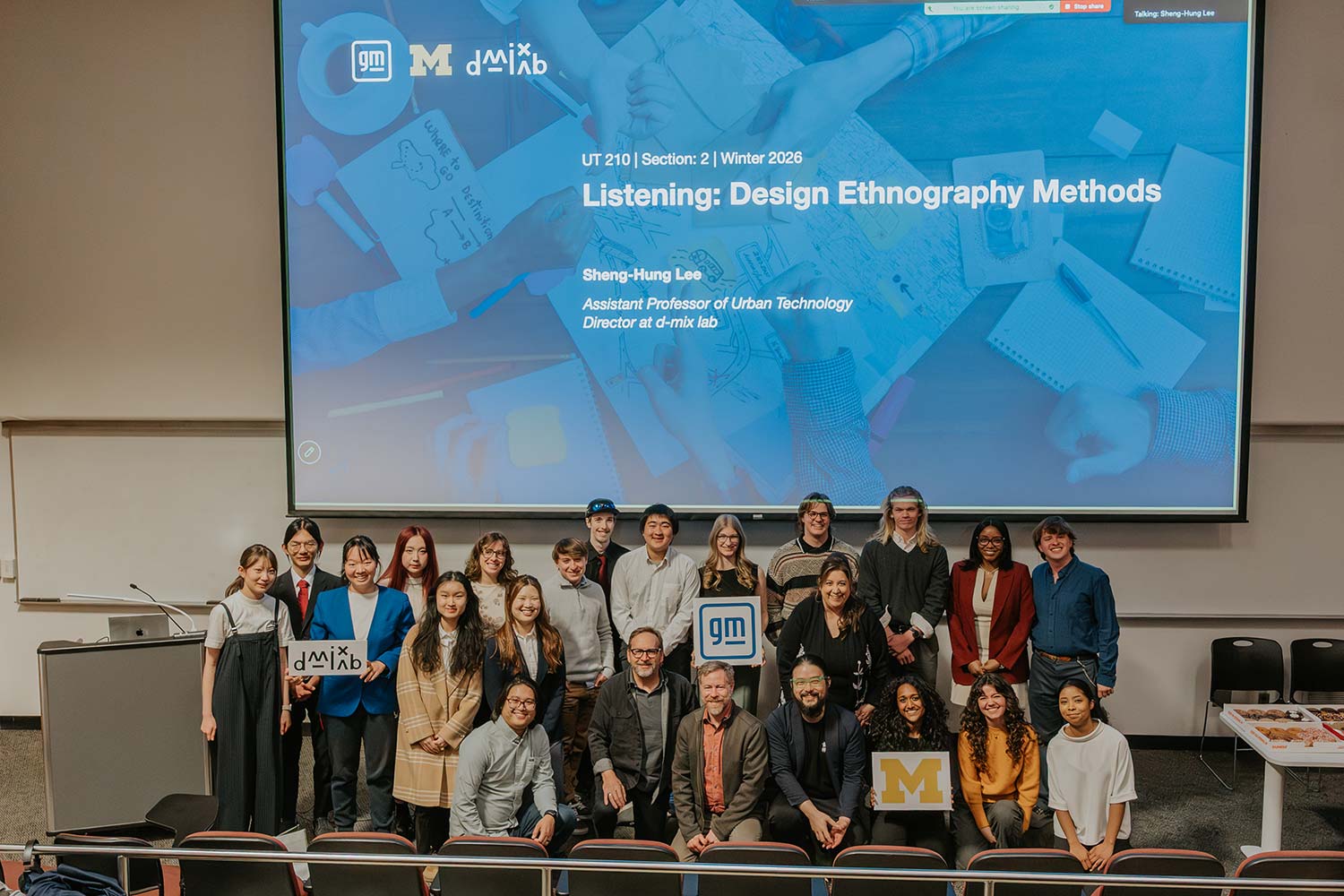
How can autonomous vehicles help foster adolescent independence or expand access to transportation? These are just a couple of big questions urban technology students spent the winter semester working to answer with industry partners General Motors and ATLAS.ti (Lumivero), as part of Sheng-Hung Lee’s UT210: Listening—Design Ethnography Methods course at Taubman College of Architecture and Urban Planning.
UT210 explores how design ethnography can inform the development of future autonomous urban systems through a human-centered, systems-oriented lens. Led by Lee, assistant professor of urban technology and director of d-mix lab, the course brought together 18 students in a studio-based, team-driven format to investigate real-world challenges at the intersection of mobility, equity, and everyday life.
“I’m also learning from everyone; I’m also a student,” said Lee, who joined the college in January. “How do you practice listening? It’s very abstract. How can you make it tangible?
Structured across three interconnected scales — peoplescape, servicescape, and cityscape — the course guides students from understanding individuals’ lived experiences to mapping service interactions and ultimately envisioning systemic urban transformations. Through ethnographic methods including interviews, observation, and qualitative analysis, students develop grounded insights into diverse contexts such as childhood autonomy, mobility exclusion, transportation deserts, and family life futures.
The course is distinguished by its close collaboration with industry partners, which allowed students to explore real-world perspectives, research tools, and feedback throughout the semester and situated their work within ongoing explorations of autonomous mobility and future urban experiences, bridging academic inquiry with applied innovation.
During a final presentation attended by representatives from GM and several Taubman College faculty and students, Wade Bryant, design manager in Advanced UX Insight and Human Interface Design at GM, said the opportunity to partner with the class was one he couldn’t pass up.
“The course itself is extremely relevant and very aligned with what we need to do,” Bryant said. “The observations and insights they’ve already uncovered are very useful to a project that we’re working on at GM that will be fairly transformational.”
Working in four teams, students translated ethnographic findings into design opportunities to address complex socio-technical challenges. The overarching theme of the course is envisioning future autonomous experiences. Within this theme, each team explored a distinct focus: in-vehicle experience and trust-building, designing for vulnerable communities, systems-level thinking, and family-centered scenarios.
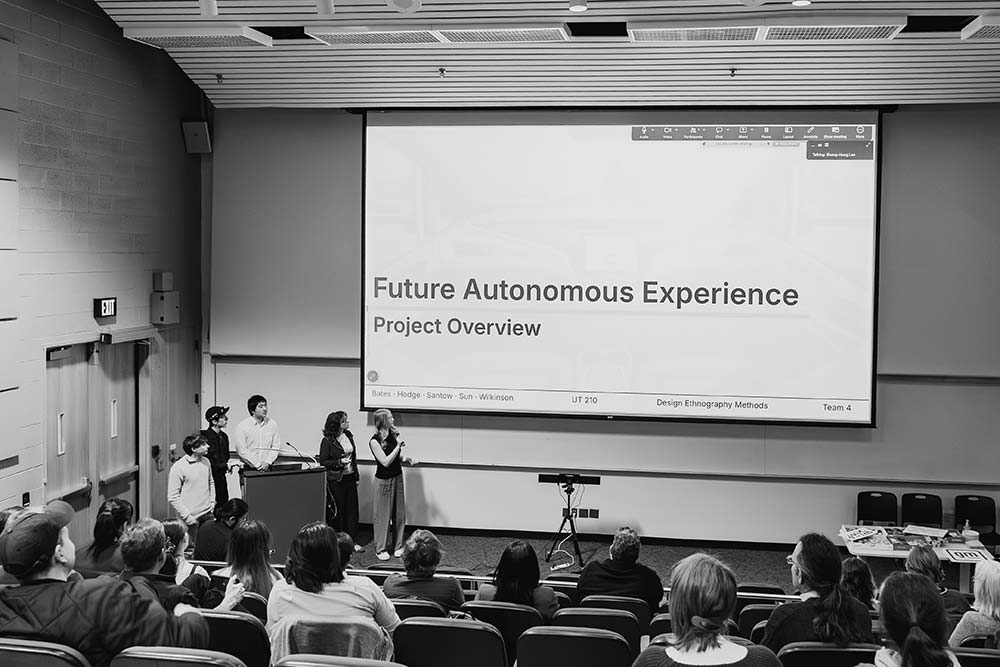
Suzette Malek, Global Customer Research Manager at GM, was interested to learn about the research methodologies currently taught at the university level, especially the mixed-methods approach used in UT210.
“It’s been amazing to see the insights from the students,” Malek said. “[They] have a great way of looking at it from a fresh pair of eyes.”
Final presentations demonstrated how team-based, research-driven design can reframe pressing urban issues and generate actionable visions for inclusive, autonomous futures. By integrating ethnographic rigor, cross-sector collaboration, and multi-scalar thinking, UT210 positions design as a critical tool for shaping the future of cities, grounded not only in technology but in human experience.
When the program was over, Lee charged students with carrying what they learned forward, focusing on their passion for the process and making a difference, rather than on assignments and grades.
“This is not the end of class: This is the beginning of class,” Lee said. “You should bring this human skill to solve different problems.”
Read more from Lee about design ethnography and UT210 at DesignWanted and in the summer issue of Michigan Alum.