Architecture at the Edge
B.S. Arch seniors explore land, climate, and memory in the Sonoran Desert
When choosing the final studio of her undergraduate architecture education, Anna DeYoung, B.S. Arch ’26, was excited to look beyond the Midwest for inspiration. She found herself drawn to designing for the Sonoran Desert in a studio led by Geoffrey Thün, professor of architecture and associate vice president for research at the U-M Office of Research.
“There’s an interesting design opportunity that comes with working in the desert, where it’s super harsh, and you have to think about things a little bit differently,” DeYoung says.
The final studio in the undergraduate series, the Wallenberg Studio, is designed to expand students’ understanding and appreciation of architecture through travel, research, and design exercises. Each year, the studio focuses on a theme that addresses humanitarian concerns. This year’s theme, “Land,” explored architecture’s role in how ground and territory are claimed, commodified, and exploited, as well as its potential to undo harm.
Desert as Studio
In Thün’s “Mavericks, the Multitude, and the Mesa” studio, students engaged with the extreme climate, vast geography, and long history of experimental, visionary, and outcast culture in Arizona’s Sonoran Desert to produce design propositions. Thün has offered “Mavericks” in some form for the past seven years, but this was the first time it was offered to undergraduate students. Teams worked on place-based projects including the world’s largest aircraft storage facility, a ghost-town turned artist commune, and a rare oasis near the U.S.-Mexico border wall.
“I tell them that it needs to be bigger than an object and smaller than a city, and may be developed through any medium,” Thün says. “People are working in landscape, they’re working in architecture, they’re designing infrastructure. They are designing through different media, from cartography to ecosystems, from actor networks to spatial frameworks and all of those things at once.”
Early in the course, students developed “detective methods,” compiled as a bilder atlas, and explored a variety of mappings to survey the territory and techniques. As they narrowed in on their projects, teams identified the various groups, policies, and social forces shaping their chosen locations and the situations they uncovered. They also studied and presented material from a list of documentary films and cartographic monographs, all carefully curated to inform the work.
“It felt like we were continuously working on one project while having these smaller assignments to help guide us, which I really appreciated,” says Gulshat Roziali, B.S. Arch ’26.
“My personal favorite was looking at the cartography books,” DeYoung says. “It was a very effective way of showing all these different styles and ways to put data into images and visual communication.”
Verifying the Field
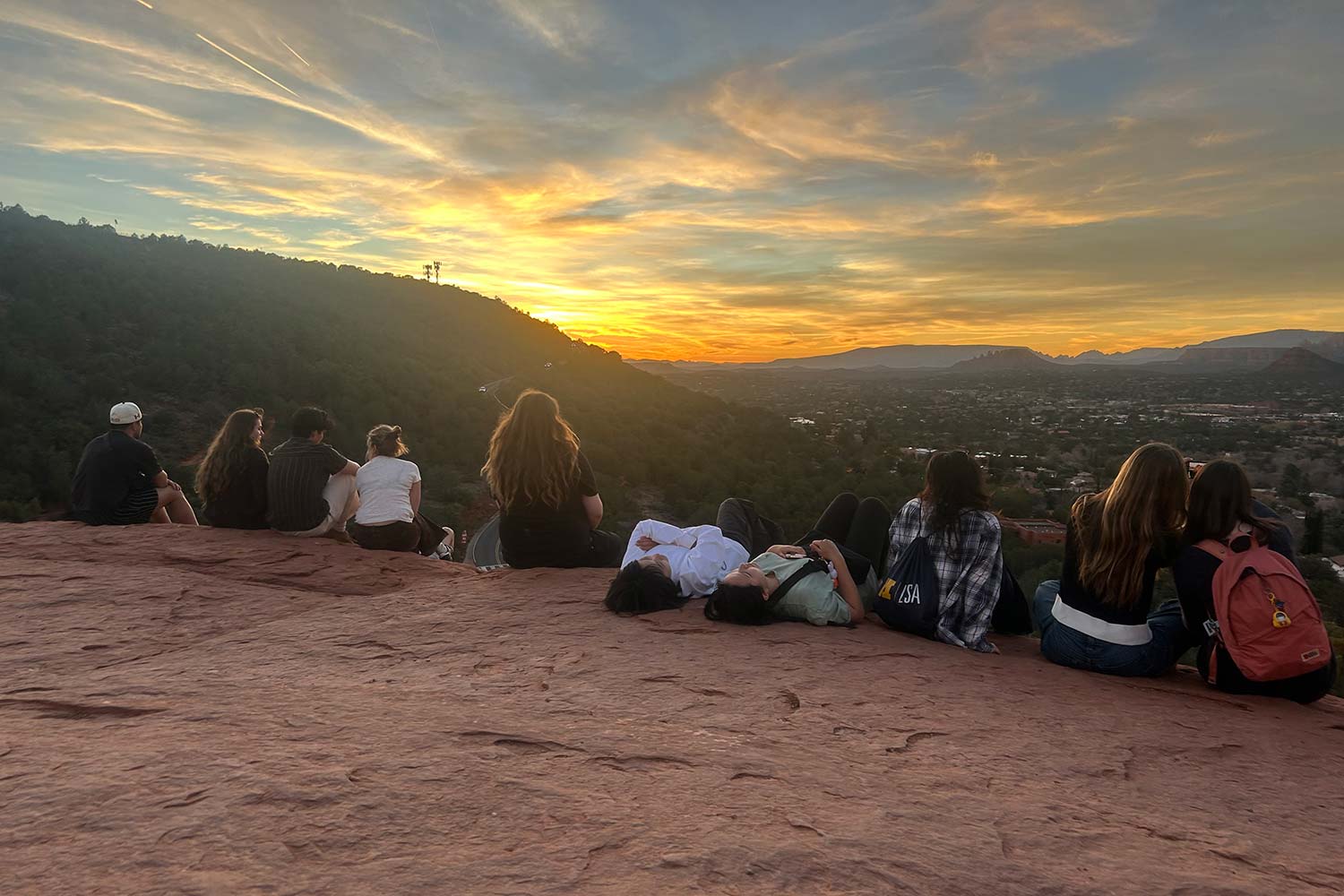
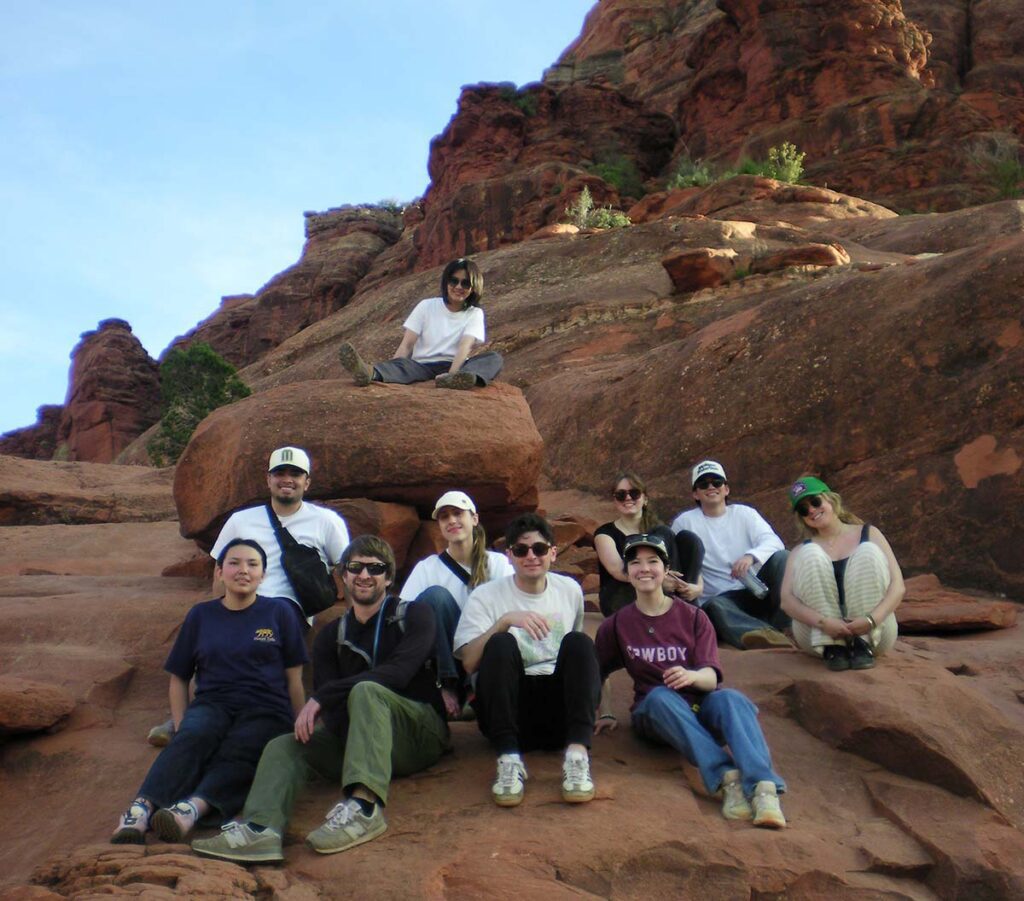
In February, the class traveled to Arizona to verify in the field what they had been studying in Ann Arbor. The five-day intensive included visits to a copper mine, military infrastructure, artist communities and installations, and a biological research center. And that was mostly on day one.
“The field trip is meant to complement their understanding through a deeply immersive, experiential way of encountering the profoundly different, strange, and sublime conditions of the Sonoran Desert,” Thün says.
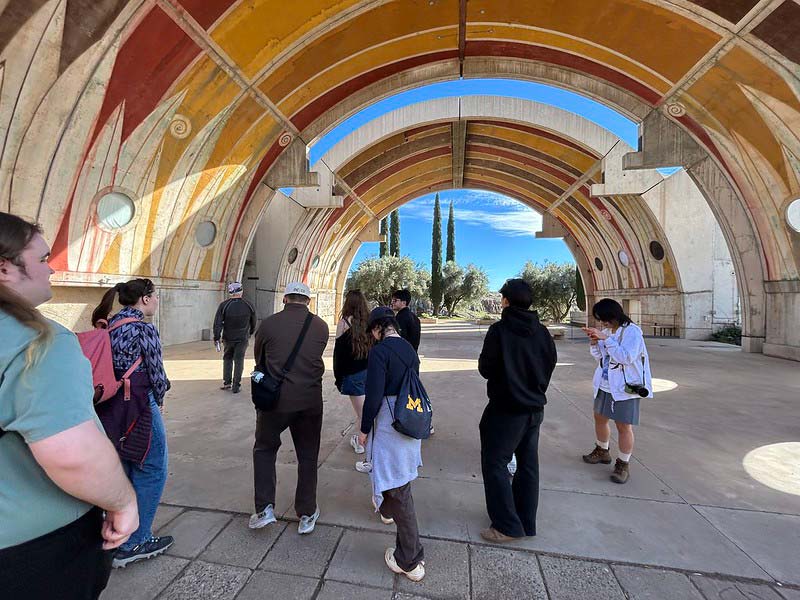
The trip was the first west of the Mississippi River for Taylor Horsfall, B.S. Arch ’26. Highlights included a nighttime visit to the Lowell Observatory, where Pluto was discovered; seeing the striking geometry of Biosphere 2; and the “staggering” experimental architecture of architect Paolo Soleri’s Arcosanti urban laboratory.
“I had seen pictures of this landscape, but I never conceptualized the vastness of it and just how big some of these complexes and how impressive these efforts were,” she says.
Watson Baek, B.S. Arch ’26, was impressed by the unconventional artwork and artist communities they encountered, as well as the desolate conditions that seemed to produce — or attract — them. Non-architectural visits to the Grand Canyon and hiking at Red Rocks were also inspiring and even “spiritual,” as students pushed themselves beyond their comfort zones in unfamiliar terrain.
Above and Below
For their project, Baek and DeYoung proposed a series of underground spaces built into the mountain that is home to Kitt Peak National Observatory. The spaces would serve as both a refuge from extreme heat and a series of vaults for preserving stories, artifacts, and biological specimens. The team’s research turned up estimates that the region will likely experience more than 100 days a year with temperatures above 100 degrees Fahrenheit by 2100. They started thinking about ways to make the region more habitable in the face of climate change.
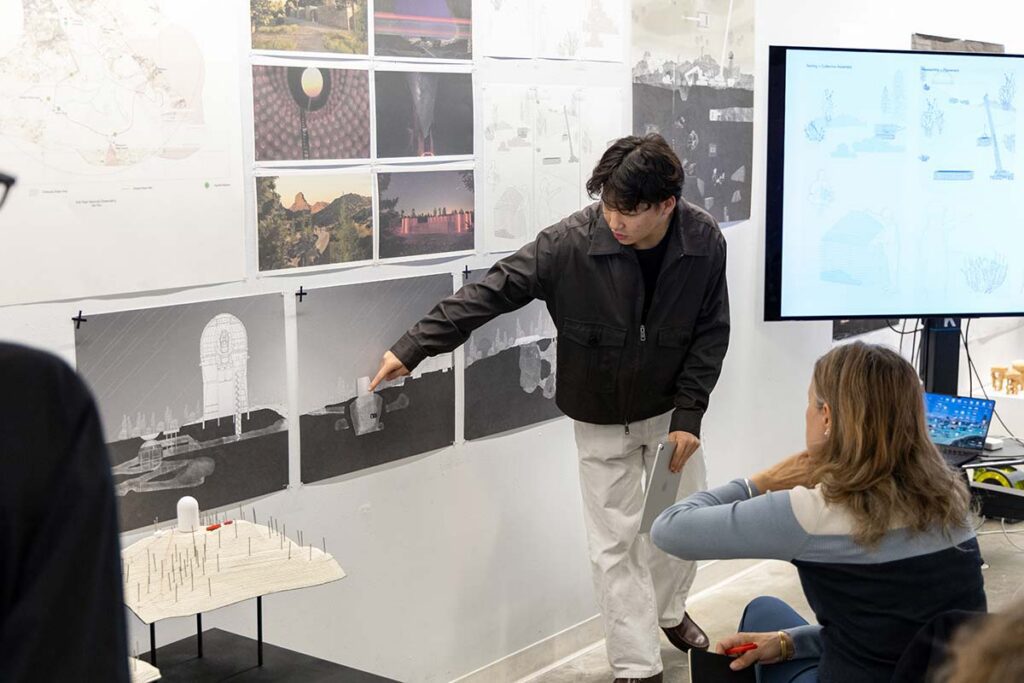
Built into the granite mountain through excavation, the spaces would be protected from surface heat and interconnected by a walking path, offering intentionally framed views of the sky above, along with dramatic temperature shifts, as users dip in and out of the mountainside. Excavated granite would be repurposed to build above-ground structures.
The team’s project incorporates existing observatory infrastructure and draws inspiration from the Tohono O’odham Nation’s understanding of the relationship between land and sky. Because the observatory is located on the Nation’s land, the team was challenged to develop its plan in a way that respected tribal sovereignty and avoided extracting value from Tohono O’odham land.
“A pivotal moment for us was looking at how the climate phenomenon is going to happen and affect the region, and it doesn’t care about cultural or national borders,” DeYoung says. “It’s something that affects us all. Moving away from an isolated framework and more toward a collective one, where we need to do this for everyone in the region, but in a way that is sensitive to the nation’s culture and honors it, was big for us.”
An Enduring Archive
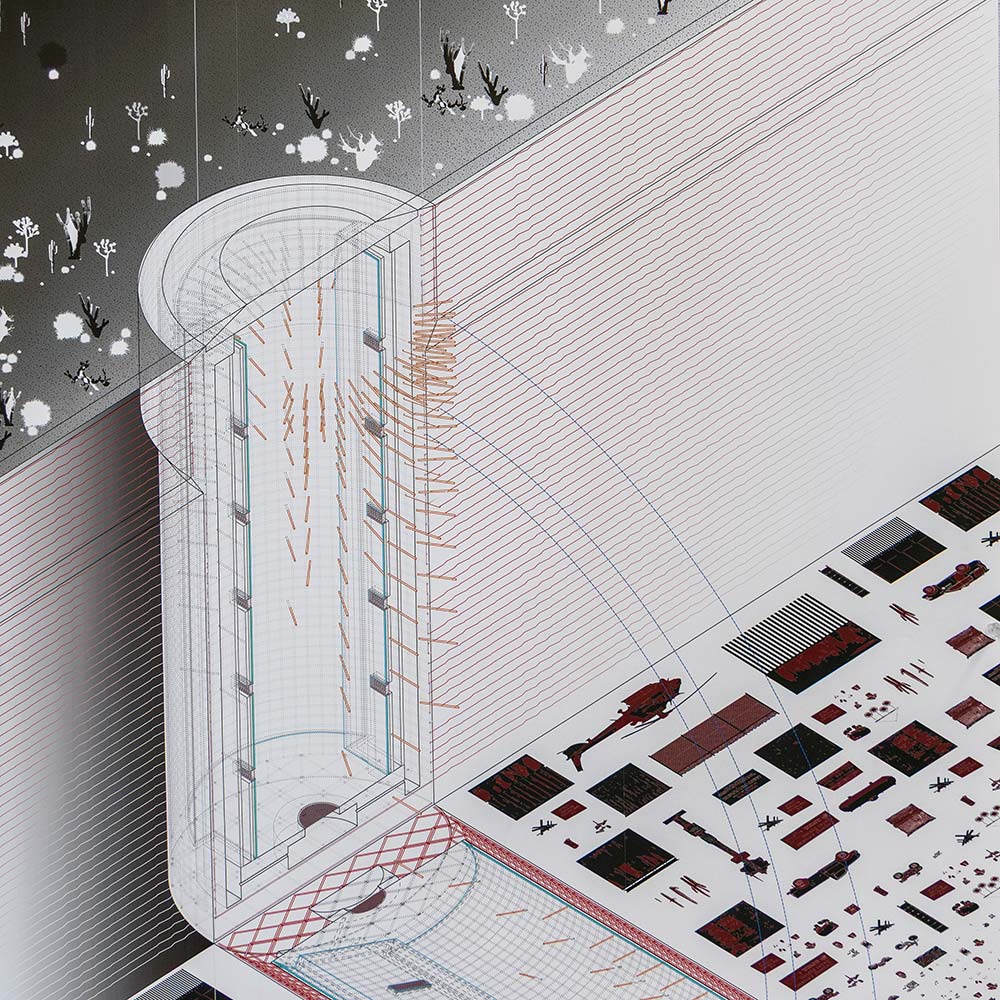
Horsfall and Roziali’s project also includes a subterranean archive, but for a different purpose. Their project, “End of the American Dream,” adapts one of Arizona’s Titan II Missile Silos into a repository for artifacts related to undocumented people crossing the border from Mexico into the U.S. In an age when digital historical records can disappear on a whim, the team set out to create a permanent, physical record of what is happening along the Arizona-Mexico border.
More than 50 underground silos were built in the U.S. during the Cold War to house massive intercontinental ballistic missiles. Most have since been destroyed, but the one remaining silo serves as a museum where visitors can observe the 100-foot-tall missile and underground control center. As the team researched the history of Cold War paranoia and military surveillance, they noticed parallels to conversations and practices around immigration in the borderlands where the museum is situated.
“The Cold War was built on the idea of othering and ‘us’ versus ‘them,’ so we were looking at that in terms of the border condition of the U.S.,” Horsfall says.
“Today, migrants are targeted as they search for the American dream, which was heavily advertised in the U.S. during the Cold War,” Roziali says. “That prosperity was promised in the land of freedom.”
An early version of the project called for repurposed Titan II sites as a series of art installations that doubled as guideposts for migrants traveling north. Realizing the idea could do more harm to those they wanted to help, the students shifted to proposing a 150-foot-deep archive that would contain everything from a military helicopter used in border patrols to pocket-sized Bibles and distressed hair braids left behind by border crossers.
“A time capsule is like the bare data of what’s happening, and we wanted to preserve that knowledge for the future,” Roziali says.
Final Review
Despite long hours in the studio, Baek says the time went quickly, thanks in part to Thün’s meticulous syllabus, complete with the infamous “squiggle” diagram of the semester.
“It gave us the perfect opportunity to get the feedback we needed to progress further into our work,” he says. “I really appreciated the way everything worked together as a culmination for the final project.”
Looking back on her final studio and undergraduate years, DeYoung says she will cherish the connections she made along with the skills she developed.
“It definitely instills a level of confidence in your work,” DeYoung says. “I know that I’m ready for whatever comes next.”
— Eric Gallippo
For more photos from this studio’s Arizona travels, visit the Taubman College Flickr page.