Sites of Reckoning
M.U.R.P. students develop frameworks for memorializing racial terror with care, honesty, and accountability
Content warning: This story includes descriptions of racial terror and lynching, including torture and murder.
Looking out over an empty patch of land surrounded by woods outside of Memphis, Irene Nguyen, M.U.R.P. ’26, felt uneasy. This same site had drawn a crowd of thousands for the racially motivated lynching of Ell Persons 109 years ago. People read about it in the paper and traveled far and wide to participate in the violence or just watch. But on this day, it was covered in tall grass and vines with no sign of the public racial terror that had taken place there.
“It was really jarring to see this memory get grown over, both metaphorically and physically,” she says. “There’s definitely a weight to it. I remember thinking, ‘This place is haunted.’”
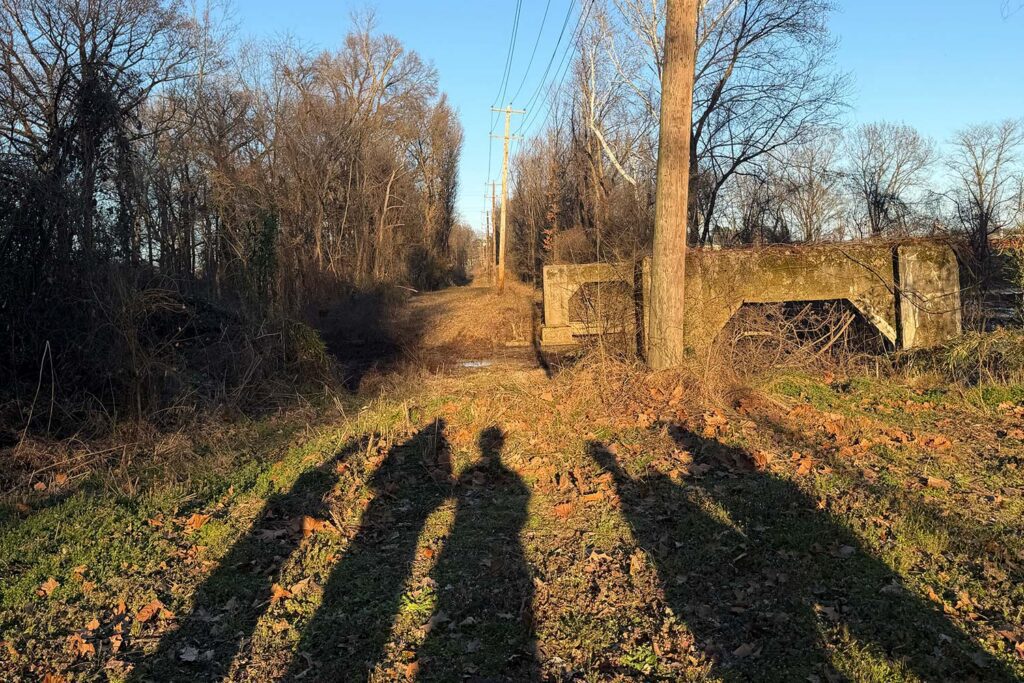
Nguyen was visiting the site with her classmates and Lauren Hood, assistant professor of practice in urban planning, last March as part of their research for Hood’s M.U.R.P. capstone course. For their project, Hood’s students explored what it means to design spaces that memorialize racial terror, using the Persons site as a real-world case study.
“They’re being asked to think through what an authentic, comprehensive acknowledgement looks like,” Hood says. “We had to think beyond the historical plaque and understand the extent to which we are willing to let history reshape how we plan, steward, and inhabit space.”
Surveying the Site
Ell Persons, a Black man, was accused of killing Antoinette Rappel, a white teenager whose body had been found in the woods near where he lived. Before he could stand trial, historical accounts indicate that he was tortured while in custody and forced to confess. A white mob later seized him while he was being transported for court proceedings, took him to the lynching site, killed him, and mutilated his body.
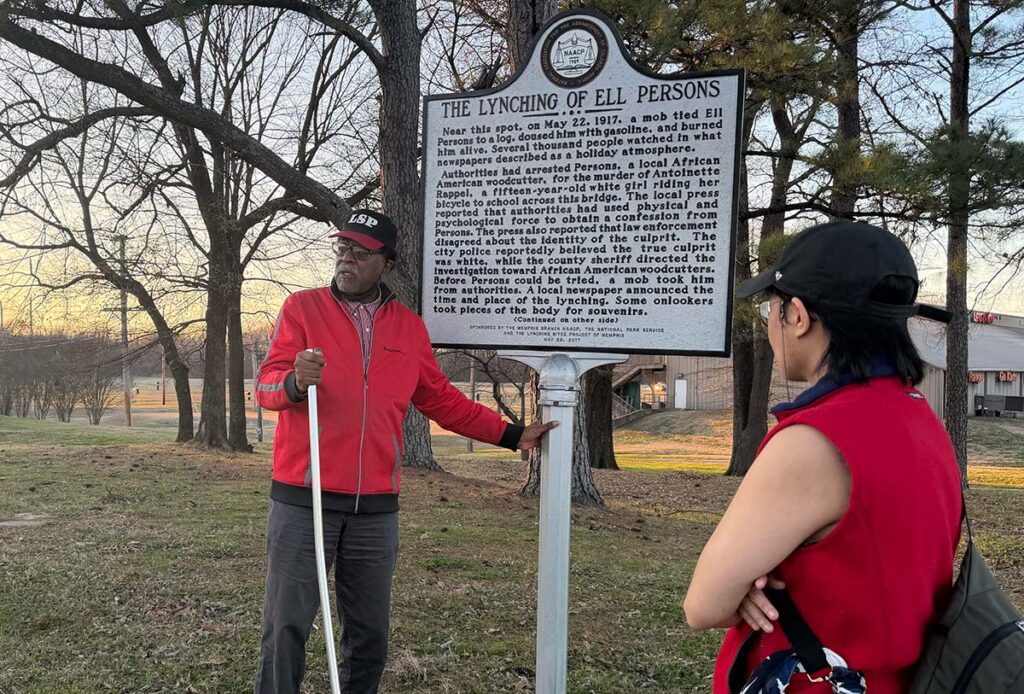
Greater Memphis witnessed the murder of an estimated 20 Black victims by lynching between 1877 and 1950, but the Persons site is particualry relevant because of the present-day interests of three independent groups: 1) The National Parks Service (NPS), which is conducting a study that could bring it under federal jurisdiction, 2) The Wolf River Conservancy, which is developing plans for a greenway project that would draw people to the remote area, and 3) the Lynching Sites Project (LSP) of Memphis, the class’s partner in the project, which has been working to memorialize this and several other local sites.
Over the course of the semester, Hood asked students to weigh the pros and cons of the site joining the NPS registry, particularly in light of recent shifts in priorities and funding, while also thinking through ways to leverage the greenway to acknowledge its history of racial terror in a way that didn’t sanitize it or turn its trauma into spectacle.
Creating Space for Critical Consciousness
Hood joined Taubman College in 2023 to change the way planning is “taught at arm’s length.”
For this capstone course, her first, she encouraged students to embrace ambiguity and trust the process of listening, reflecting, and imagining new possibilities, expanding their practice beyond data analysis, mapping, and site planning.
“We need technical expertise, but we also need a critical consciousness,” she says. “I need students to situate themselves in this work and not be agnostic.”
To help build that consciousness, students brought in photos of their younger selves as a reminder of each other’s humanity and spent the first part of the course laying out ground rules for working through sensitive subject matter. They also visited the Charles H. Wright Museum of African American History in Detroit and the Zekelman Holocaust Center in Farmington Hills, Michigan, and held impromptu class discussions about notable monuments and what makes them memorable. One early assignment asked them to present ways their own cultural identities had been memorialized.
“Lauren encouraged us to explore our own vulnerabilities,” says Amina Dunn, M.S./M.U.R.P. ’26. “We had to be able to disagree and talk about things that we don’t want to talk about — to create space and mechanisms that allow us to establish boundaries, break down walls, and interrogate our own failures in this work as well.”
“This topic requires a lot of trust, more so than any group project we have done in the past,” Nguyen says. “Urban planning is very collaborative, but this required a certain sensitivity and openness to communicate.”
Big Hugs, Bigger Conversations
In Memphis, LSP volunteers led the class to the unmarked site of Persons’ lynching; to the existing historical marker in the city, placed where members of the mob used his remains to further terrorize Black residents after his murder; and to another local lynching site. The students spent hours talking with LSP board members about their goals and how the NPS survey and greenway project might impact them, met with the Wolf River Conservancy, and visited the National Civil Rights Museum.
Xilong Wang, M.U.R.P. ’26, joined Hood’s capstone for a different experience from his previous focus on data and GIS, which he often worked on alone. Working with others was a new challenge, as was learning about different cultures and aspects of American history that were unfamiliar to him as someone from China. He was surprised to learn the complex history behind each story.
“For one event, there might be several locations involved, but only some of them have been confirmed,” he says. “A lot of details have been lost.”
Even though she arrived a day after her classmates, Dunn felt immediately embraced and respected by their hosts at LSP.
“It was like, open with a hug, and then, ‘These are the sites. Let’s start having really deep conversations about them,’” she says. “They really took our impressions and thoughts on how to engage with the sites seriously, because they are very interested in outside perspectives and what people feel about them, seeing them for the first time.”
Informed by their work on the ground, following weeks of preparation back in Ann Arbor, the project began to take shape.
“Once we talked to folks and spent time there, things emerged for us,” Nguyen says. “After sitting with it and actively listening, observing the sites, the people, the organizers, and the city at large, that was when a lot of our gears started turning about how we should move forward.”
Looking Back to Move Forward
For their final presentation on their work, Dunn, Nguyen, Wang, and M.U.R.P. ’26 classmates Ali Eletrache, Jordan Hunter, and Rubin Malik, presented the report they had produced, including guidelines for planning the Persons lynching site.
“Stories, Spaces, & Sankofa: Frameworks for Commemorating Sites of Racial Terror” emphasizes the importance of “Sankofa,” the Ghanaian concept that “It is not taboo to go back for what you forgot.” In this case, acknowledging the history of lynching in many U.S. communities, like Memphis, is the “first pathway toward reconciliation.”
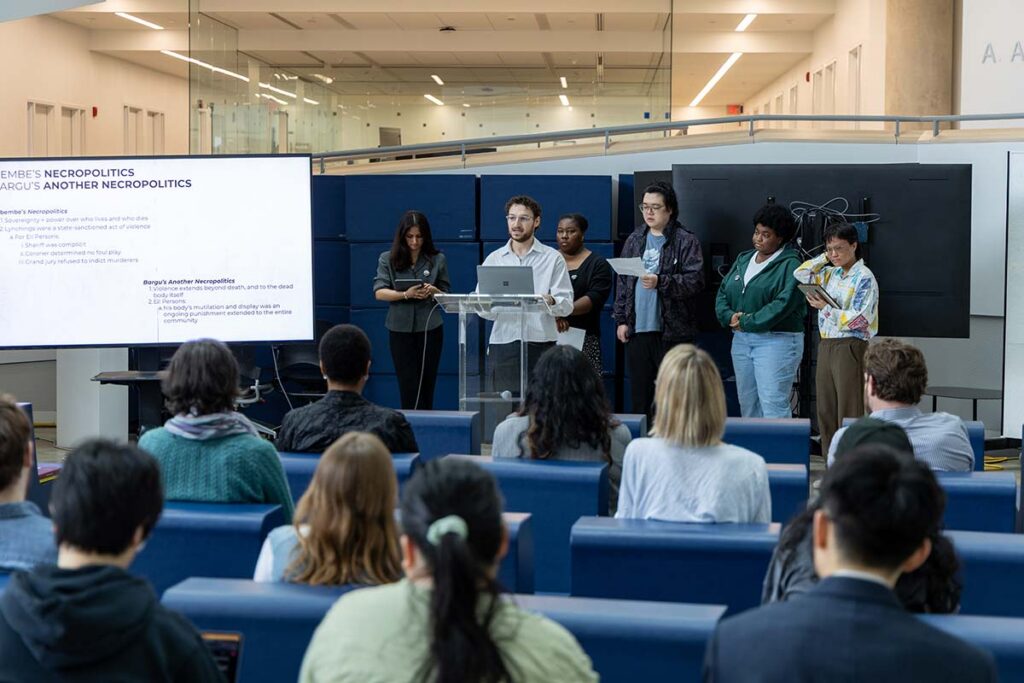
Ultimately, the group recommends that LSP help oversee and inform any future plans for the site, whether or not it is added to the NPS. To fund its work, the group recommends that LSP partner with a nonprofit, such as the nearby National Civil Rights Museum, which has a similar mission. While they do not recommend a design for the memorial itself, the group cited two examples of successful memorializations of lynchings for reference: the Ed Johnson Memorial in Chattanooga, Tennessee, and the National Memorial for Peace and Justice in Montgomery, Alabama.
“I appreciate projects like this because it shows that you can look into yourself as well,” Malik says. “Approaching our work intentionally, following the principle of Sankofa, and going back step by step was really critical in our process.”
Growing up in white spaces, Hunter says she tended to shy away from the harder aspects of Black history, which she now realizes only causes more harm.
“In urban planning, we have a tendency to distance ourselves from our work and from the community, but the more we do that, the more ineffective we become in our role,” she says.
Through her capstone, she’s come to realize, “My work is informed by the fact that I am Black. I can try to separate those things all day long. It’s never going to happen.”
“This capstone really allowed me to be more comfortable with that and to articulate that in ways I didn’t really think I’d be able to.”
— Eric Gallippo