‘Tradition is not safe’: Boyer urges new approaches to architecture and planning in Tec de Monterrey lecture
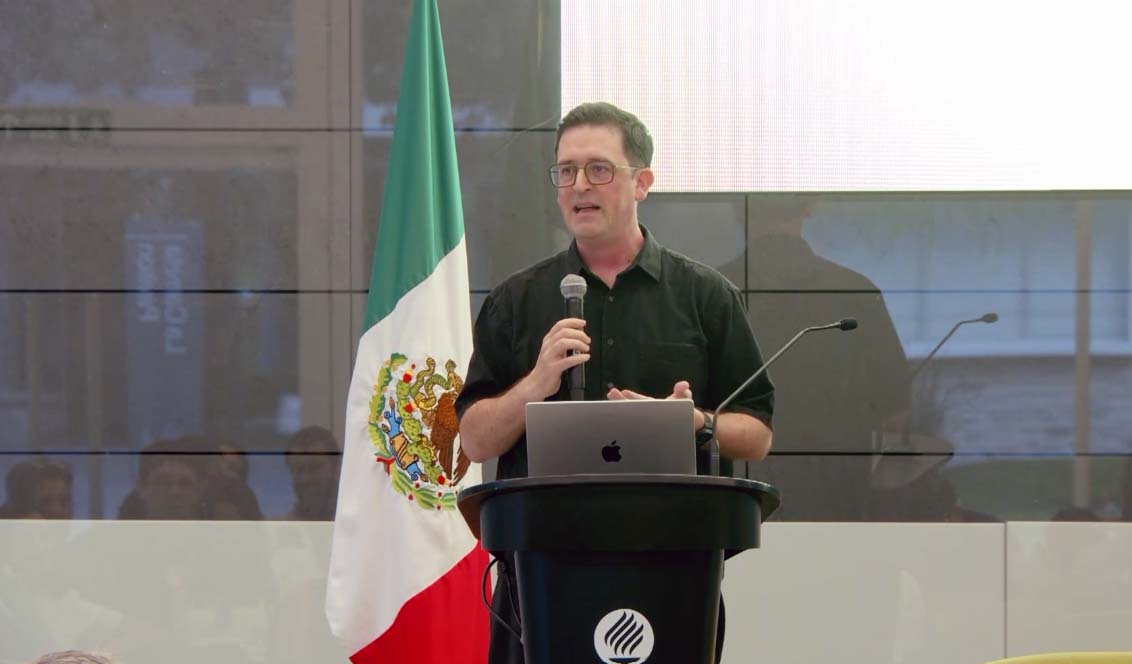
How can architects, planners, and others working in the built environment harness today’s technology to break through in a stagnant construction industry? Taubman College’s Bryan Boyer posed this and other questions during a guest lecture at Mexico’s Escuela de Arquitectura, Arte y Diseño at Tecnológico de Monterrey last month. His talk, entitled “Will Technology Eat the Built Environment?” was part of Tec de Monterrey’s Creative Leaders series.
Boyer is an associate professor of practice and the faculty director of the Master of Urban Technology degree and of the University of Michigan Center for Innovation. He began his presentation by asking why it is so hard to do anything in the built environment. “Too much of what we do is too close to Geppetto’s workshop. We are artisanal with every single decision, and it is exhausting,” he said.
Boyer wants to help architects and planners spend more time on work closer to architecture’s goals of enabling new ways of living, rather than agonizing over small decisions. His lecture promoted a “strategic design” approach that emphasizes asking the right questions, identifying the social and economic value a project aims to create, and transcending silos between traditional disciplines. He gave an example of a town in Finland that increased attendance at a local public pool not by renovating the building but by reconfiguring the bus schedule to better align with the pool’s hours.
He also discussed how to rethink architecture and planning practice for today’s technological age, including his latest research on “Chain Drain,” which examines what is lost as projects move between construction, architecture, and engineering with little coordination. As firms work to manage these inefficiencies, Boyer said productivity in construction, architecture, and planning has stayed flat, while other industries, such as agriculture and manufacturing, have experienced dramatic gains.
As a result, large technology and venture capital firms have started acknowledging a market opportunity. Boyer’s research chronicles more than 300 tech companies working to disrupt various parts of this ecosystem. Beyond business implications, lagging productivity affects how we address pressing social problems. “If we really care about climate change, why don’t we want to be 100 times more productive?” Boyer said.
Ultimately, Boyer urged architects and others in built environment professions to embrace new ways of working to adapt to this new reality. “Doing nothing, participating in the kind of atelier model of architecture and the traditional supply chain of the built environment, is not a safe harbor anymore,” he said. “Tradition is not safe at this moment, and so we desperately, as a community of practitioners … need to be involved in thinking about what’s next. Because if we don’t do it, somebody else will.”
Watch the full lecture on the Tecnológico de Monterrey’s Live.Tec platform.
— By Carter Howe, M.U.R.P. ’28