Answering the Call
Renée M. Russell, B.S. Arch ’75, M.Arch ’76, empowers the next generation through a planned gift and endowed scholarship
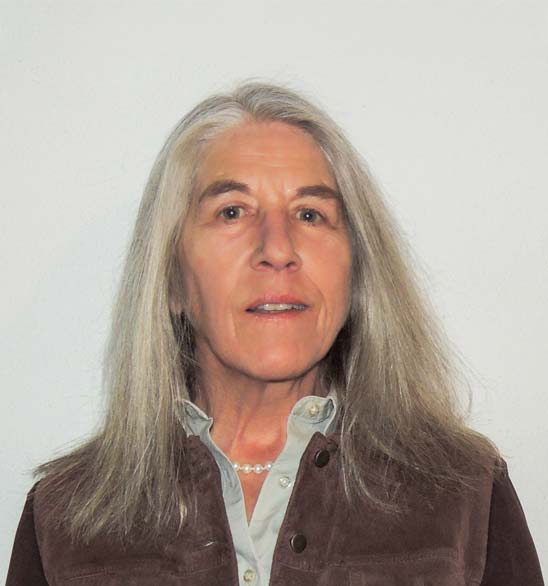
Renée Russell’s, B.S. Arch ’75, M.Arch ’76, pursuit of architecture led her from the Detroit suburbs to the East Coast to military bases in Germany and Virginia. As an architect, planner, and project manager with the U.S. Army and the Army Corps of Engineers, her overseas tour overlapped with the fall of the Berlin Wall and the launch of operations Desert Shield and Desert Storm, which relied heavily on U.S. deployments from Germany.
Returning to the United States, Russell transferred to the U.S. Navy, serving as an architect at the Norfolk Naval Shipyard (NNSY) in Portsmouth, Virginia, for 23 years, during which she advanced to senior architect for the Naval Facilities Engineering Command. Since retiring in 2017, she has continued to work as a registered architect (mostly on jobs that sound fun) and stay active in her professional and local communities; she’s an emeritus member of the American Institute of Architects and board member of the Naval Civilian Managers Association – NNSY Chapter.
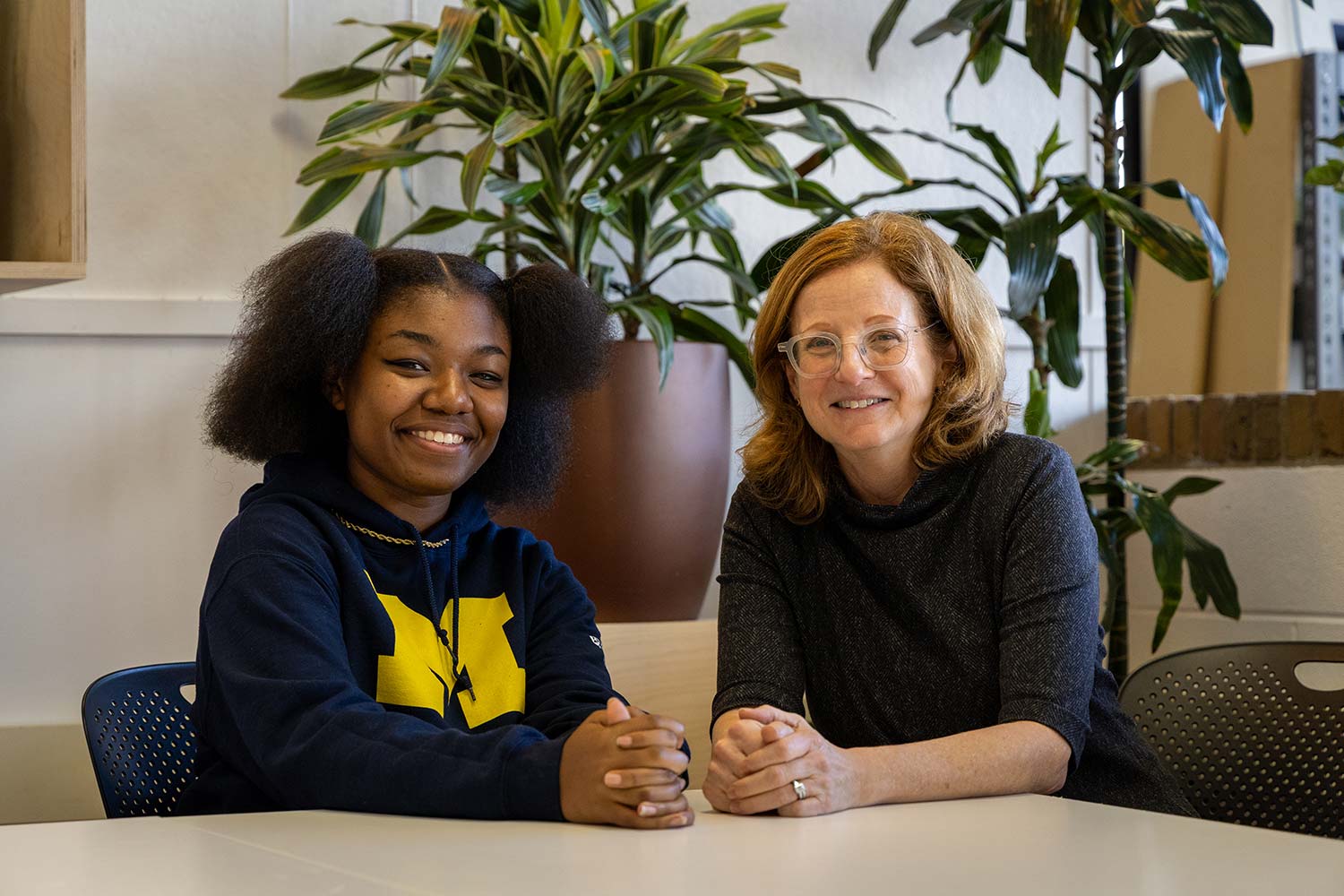
Russell’s interests have shifted from entrepreneurial to philanthropic in recent years. In addition to making a planned gift to Taubman College, she has also established an endowed scholarship. Through the Renée M. Russell Architecture Scholarship Fund, she hopes to help the next generation of architecture students follow their passion, wherever it may lead them.
“I want to inspire students to embrace architecture, not just as a career, but as a calling,” she says.
Early adopter
Russell’s own calling came after taking part in a drafting class, which was still rare for girls at the time, as a high school senior in Bloomfield Hills, Michigan.
“I loved drawing, was good at math, and loved the Prairie architecture of Frank Lloyd Wright,” Russell says. “I decided that architecture would be a good profession for me.”
At the University of Michigan, her first architecture classes were held on central campus before moving into the new Art & Architecture Building on North Campus. Russell loved studying design, construction, and environmental technology, as well as classes on landscape architecture and historic preservation. She enjoyed learning new skills and adopting new tools, from large-format photography with Harold Himes to exploring 3D models with innovative video techniques developed by Norm Barnett in the college’s Visual Simulation Lab.
Russell was also active in organizations and clubs. As part of the Professional Exposure Program (PEP), she led her mock firm’s technical efforts by developing an electronic payroll system to manage complex earnings and deductions. Computers were still new, and lines of code had to be entered onto punch cards and processed at the North Campus computing center.
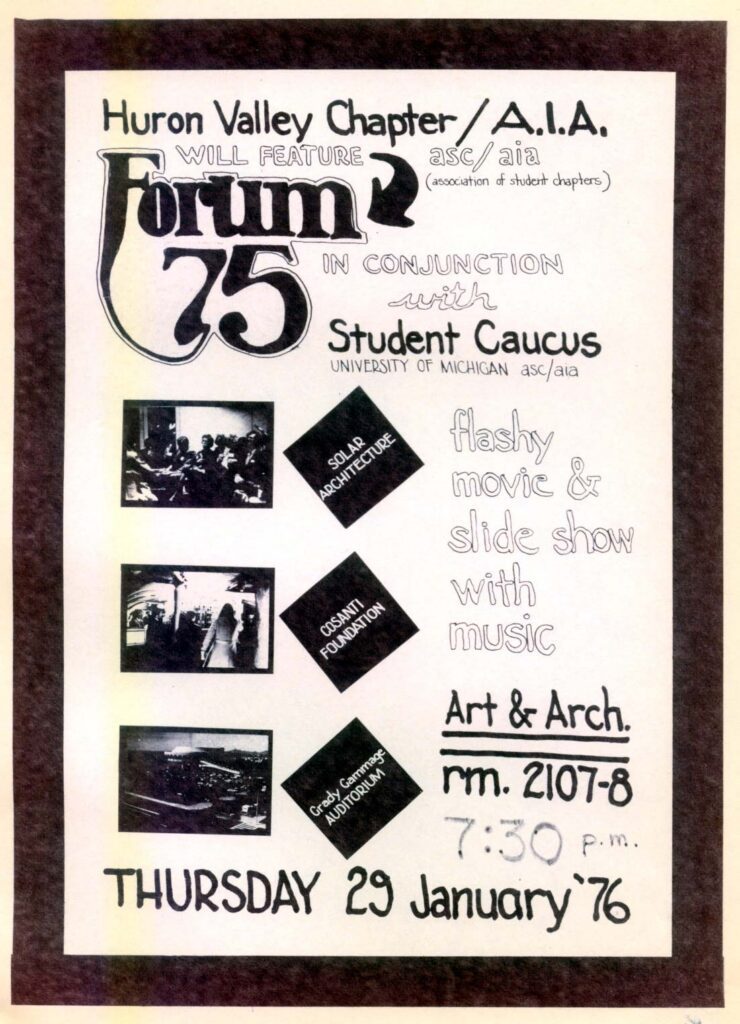
She also joined the Construction Specifications Institute and became a student member of the American Institute of Architects, which she led at U-M in 1975 and 1976. The latter took her to Tempe, Arizona, to attend the Associated Student Chapters of the AIA’s annual forum.
“The big topic was solar architecture and passive systems for conserving resources,” Russell says. “At that time, solar systems were very experimental and costly. We all became more environmentally and sustainability aware.”
Russell excelled despite being one of only a few women in her class and sexist attitudes toward women architects at the time (she recalls being told, “The best thing for you to do is marry an architect, and then you can be an architect”). She served on the college executive committee as a student and, after graduating, received the Marian Sarah Parker Award for Outstanding Woman Student of the Year. She also served on the NAAB Review Board as a student representative reviewing Howard University for accreditation.
Over there, and back
After graduation, Russell struggled to find work in architecture. She took a job as a technical illustrator in Boston and then as a freelance photographer and graphic designer during New York’s booming disco scene before getting hired as an architect by the U.S. Army Corps of Engineers.
“My original thought was, ‘I’ll get on-board experience for three years to qualify for the architectural registration exam.’ Three years stretched into five years. Five years stretched into an overseas appointment.”
At the U.S. Military Community Activity (USMCA) in Aschaffenburg, Germany, Russell served as master-planning supervisory architect, responsible for developing and maintaining the base’s master plan and property documentation. In her free time, she travelled and volunteered as the neighborhood troop committee chair for the U.S.A. Girl Scouts in Aschaffenburg. After transferring back to the Army Corps of Engineers a few years later, she became a master planning project manager in Frankfurt. Her work included supporting the development of U.S. embassies in the newly independent states of the former Soviet Union, as well as developing and managing contracts for master planning products across Europe. Those contracts included environmental surveys for endangered and threatened species on military training lands.
At the end of her tour, Russell transferred to the U.S. Navy at Norfolk Naval Shipyard (NNSY) in Virginia, where she worked as an architect for the rest of her career. As architect-in-charge, her projects included industrial building renovations, adaptive reuse of existing facilities, expansion of production facilities, and historic preservation. She also oversaw the implementation of major regional efforts to conserve energy, from developing renewable sources to modernizing facilities to auditing opportunities for improvement.
Today, Russell still visits the shipyard for meetings of the Naval Civilian Managers Association, stays in touch with fellow retirees, and contributes to the Friends of the Portsmouth Naval Shipyard Museum.
“It’s a very historic base. NNSY is older than the country, so it’s a pretty interesting place to be,” she says.
Shaping the future
After deciding to make a planned gift to Taubman College as part of her estate, Russell realized she wanted to do more to benefit students today.
“I want my legacy to extend beyond my own achievements,” she says. “I believe in empowering the next generation.”
With her new scholarship, to be awarded for the first time this fall, she hopes to help lessen the burden for busy students working to complete the program, land internships, and become registered architects, all while managing the growing responsibilities of young adulthood.
“I encourage students to engage in professional and civic activities, recognizing that true success is found in protecting the health, safety, and welfare of the public,” she says. “By fostering collaboration between architects, engineers, clients, and regulators, today’s students will become architectural leaders who shape the future.”
— Eric Gallippo
Main Image: Renée Russell during her time at Michigan