Casting the Future
M.Arch thesis students rethink concrete labor, formwork, and sustainability
A week before final reviews for their master’s thesis studio, M.Arch ’26 students Andrew Masternak and Felix Lam had a problem. They had just poured the base of an 8-foot-tall concrete column, and something was wrong. The paper-based formwork they designed was holding on the sides as planned, but a seal at the bottom had leaked, allowing concrete to flow where it wasn’t supposed to and causing it to balloon on one side.
A complication wasn’t completely unexpected: After a dozen iterations and a semester’s worth of experimenting, this was their largest piece yet, at 45 liters of concrete weighing nearly 200 lbs. The larger scale meant adjusting how their careful formwork was assembled. Now it would take days before the concrete had set enough for them to attempt any of the workarounds they were brainstorming on the spot.
“The parts that were designed for this are holding up,” Masternak said, optimistically. “All the new stuff is seeming to fail, which is unfortunate.”
Laying the Foundation
Learning through failure is part of the experience when experimenting with an unforgiving material like concrete, a fact students in Tsz Yan Ng’s M.Arch studio were well aware of at this point in the year.
Students in the final year of their M.Arch degree at Taubman College participate in a year-long thesis, starting with a seminar course in the fall, followed by a design studio in the winter. Each studio has a theme, which students select through balloting. This year, 81 students took part in seven studios covering architecture’s agency in society, rethinking architectural education, architecture’s place in the natural world, and more.
In Concrete Labor_Circularity, students worked with Ng, associate professor of architecture, for an intensive exploration of concrete formwork with a focus on advanced digital fabrication. To support that work, the studio is paired with Professor Wes McGee’s Advanced Robotics class, giving students more opportunities to push their research and explore cutting-edge tools and software alongside traditional concrete-forming techniques. Over the semester, teams experimented with a range of methods and materials, from using fabric as formwork to casting with clay.
“The question is how new technologies would inform the way that we design with concrete,” Ng says.
This year’s studio also centered on “circularity,” with an emphasis on building efficiency and reducing waste. Concrete construction is widely reported as a major contributor to Earth’s carbon emissions, accounting for 8% globally. Working in six teams of two, thesis students were charged with reducing construction waste and cement use by developing more efficient, reusable processes and formwork systems. Each team worked toward casting a 1:1, full-scale prototype of its design.
“Part of the course is really trying to understand the full gamut of how we form concrete, so we can rethink how we use concrete as a building material,” Ng says. “How can we employ new technologies to reduce formwork labor and material waste, and also what new designs could emerge out of it?”
Inspiring Innovations
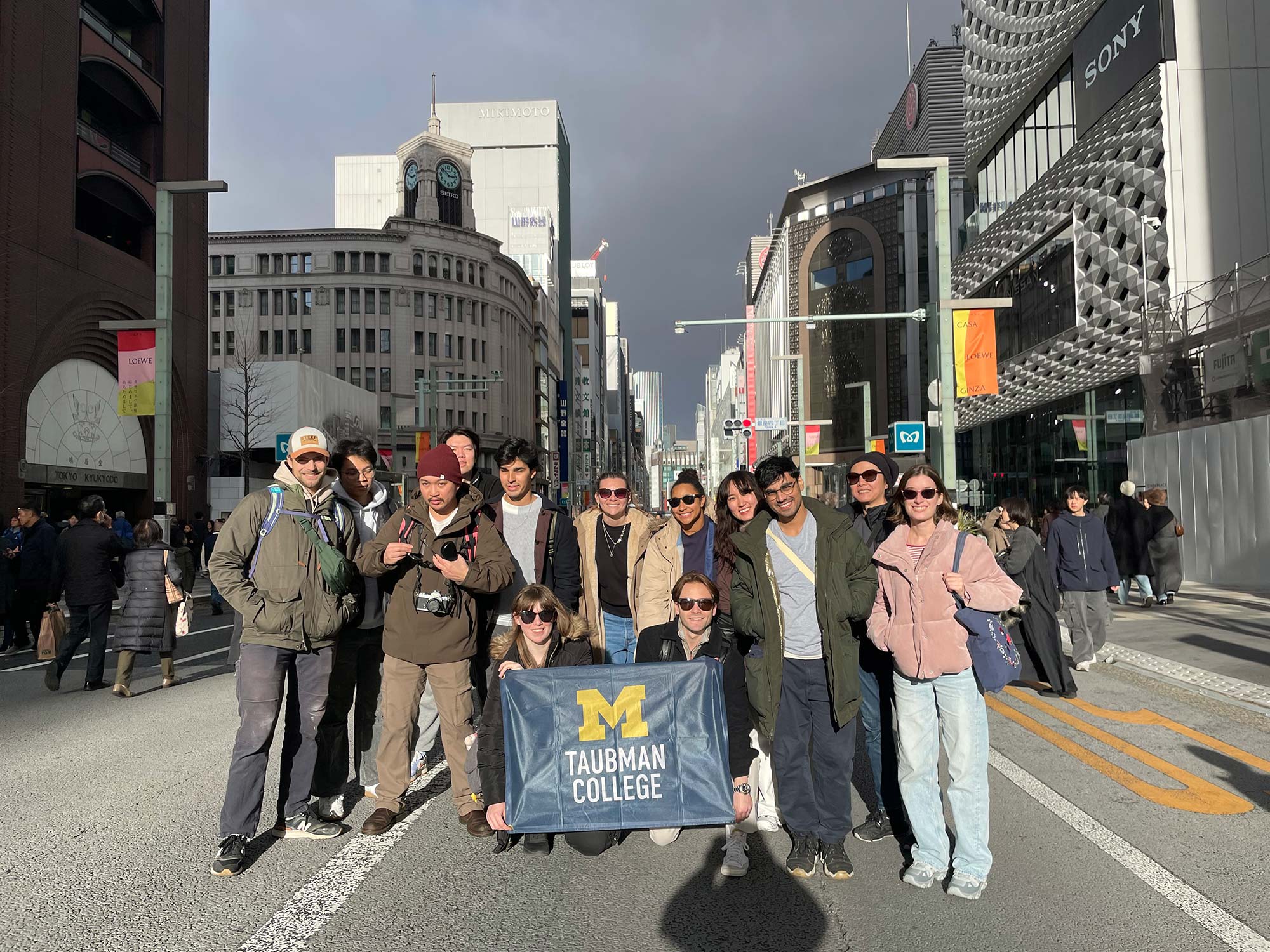
After getting an overview of the history of concrete formwork and basics of mixing and casting in the fall, students narrow in on a technique to explore in depth in the winter studio. To help inspire them, Ng took her students to Japan at the start of the term. Through site visits in Tokyo, Kyoto, and elsewhere, they encountered time-tested practices alongside innovative uses of concrete beyond what many had experienced before.
“They really were looking at the different techniques for concrete work that they can relate to in their production,” Ng says.
“We were able to see a lot of experimental forms of technologies and ways the concrete has evolved over the years and ways that materials come together,” Lam says. “That was really eye-opening.”
“They have a level of craft that was inspiring,” says James Sotiroff, M.Arch ’26. “Here, concrete is used for your floors, some precast walls, and that’s kind of it. But over there, it was definitely pushed. You saw it as a finished surface, you saw it as entire buildings. It was inspiring to see how expansive their designs could be.”
Lightening the Load
Back in Ann Arbor, Sotiroff and teammate Pablo De La Garza visited a local concrete recycling center in nearby Whitmore Lake for a tour and overview of how it breaks down demolished concrete into rubble. Seeing the process in person got them thinking about expanded uses for recycled rubble that would also use less concrete overall.
“In the U.S., concrete is just broken down and used as base material for roads and foundations, but that’s it,” De La Garza says. “It’s downcycled. For us, it’s about, ‘How can we upcycle it?’”

Inspired by others’ work with reused materials and their own research on autoclaved aerated concrete (AAC) — popular in parts of Europe for its light weight and thermal, acoustic, and fire-resistant properties — they began mixing foam, concrete, rubble, and other additives to produce a series of sample cubes of varying densities. Their eventual goal was to create a lightweight material to fill the hollow sections of a 4-by-4-foot composite wall, drawing inspiration from a design they had seen in Japan and a concrete tilt-up wall precedent in Los Angeles.
After hours of research and experimentation, they landed on a mixture they felt hit the mark for weight and strength. The rubble never quite cooperated, though, either settling to the bottom or floating to the top. Shifting gears, they incorporated it as reinforcement into the wall’s concrete outer frame.
The frame and formwork for their wall were also optimized for efficiency. Originally working with a hand-assembled rectangular frame, McGee helped them develop a structurally efficient design featuring CNC-routed formwork, which allowed for a better ratio of concrete to foam-crete. Their resulting wall weighed 343 lbs — 170 lbs lighter than a comparable panel cast in solid concrete — and reduced carbon emissions by an estimated 55%.
Gripping Discoveries
Cayla Ellis and Amely Wackerbauer, both M.Arch ’26, were inspired by the textured surfaces they encountered across Japan. Hand-stippled “pokey patterns” at the Kyoto International Conference Center, rough aggregate blended with smooth panels at the Tokyo Metropolitan Festival Hall, and wood grain imprinted into slabs in Shinjuku Rurikoin Byakurengedo temple invite touch, break up monotony and scale, and add warmth to concrete.
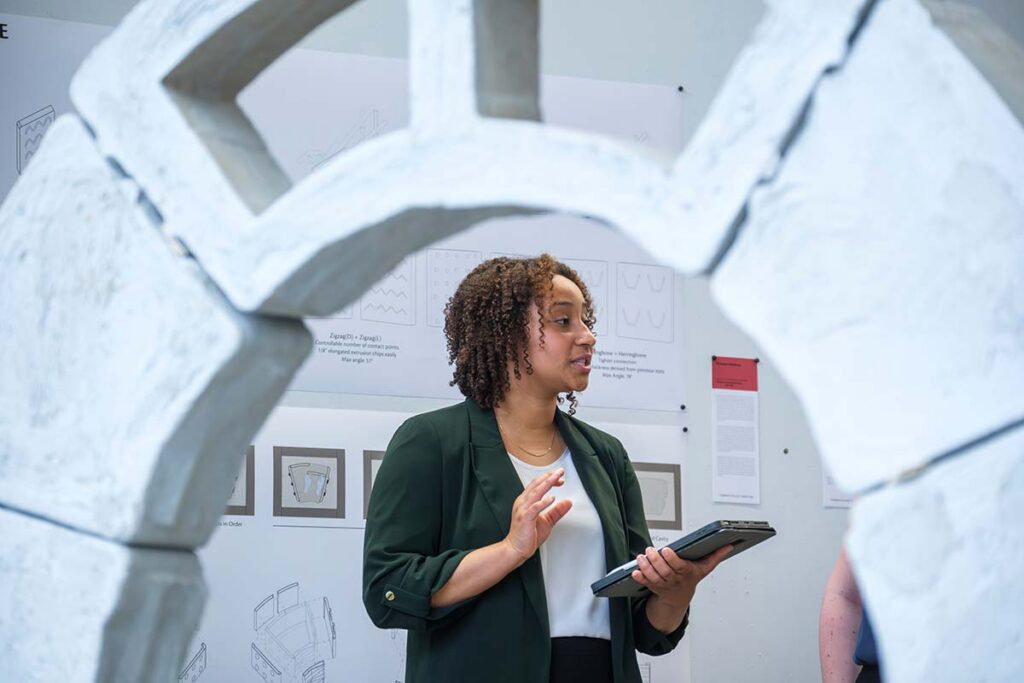
For their investigation, they decided to explore how textured surfaces could help components “stick” together. They created a series of sand-cast textured slabs to test which patterns worked best through friction, and also the angle at which they started to slide. Next, they cast concrete blocks with high-friction surfaces and carefully adjusted centers of mass, enabling the team to stack them into an arch without support scaffolding before setting the keystone.
To cast their blocks, the team used robotic 3D printing to produce precise molds, which they then packed in a simple mixture of sand and bentonite. Once the printed mold is removed, concrete is cast into the relief cavity left in the sand. When the blocks are finished, both the printed molds and the sand can be reused. One happy accident: the 3D-printed molds left behind an additional grooved texture in the sand that transferred to the blocks.
Wackerbauer was drawn to Taubman College for its fabrication capabilities and chose Ng’s thesis for more hands-on work.
“It’s one thing to take an elective that’s heavy in fabrication, but then to take the entire studio … I was really excited for it,” she says. “I would rather be in the research room working on physical things versus staying up late staring at a screen.”
Into the Fold
Japan influenced both the form and function of Masternak and Lam’s thesis project. Inspired by origami, the team developed a process for casting concrete with folded paper and outer cardboard ribs. The result was an easy-to-produce, compact, and reusable formwork system for installing columns in places where heavy machinery is difficult to deploy, from dense cities to remote mountain villages.
“The Japan trip taught us to kind of keep it minimal and keep a clean aesthetic to it,” Lam says.
“For me, there’s been a lot of reflection on the urban environment and how our scheme fits into that context,” Masternak says.
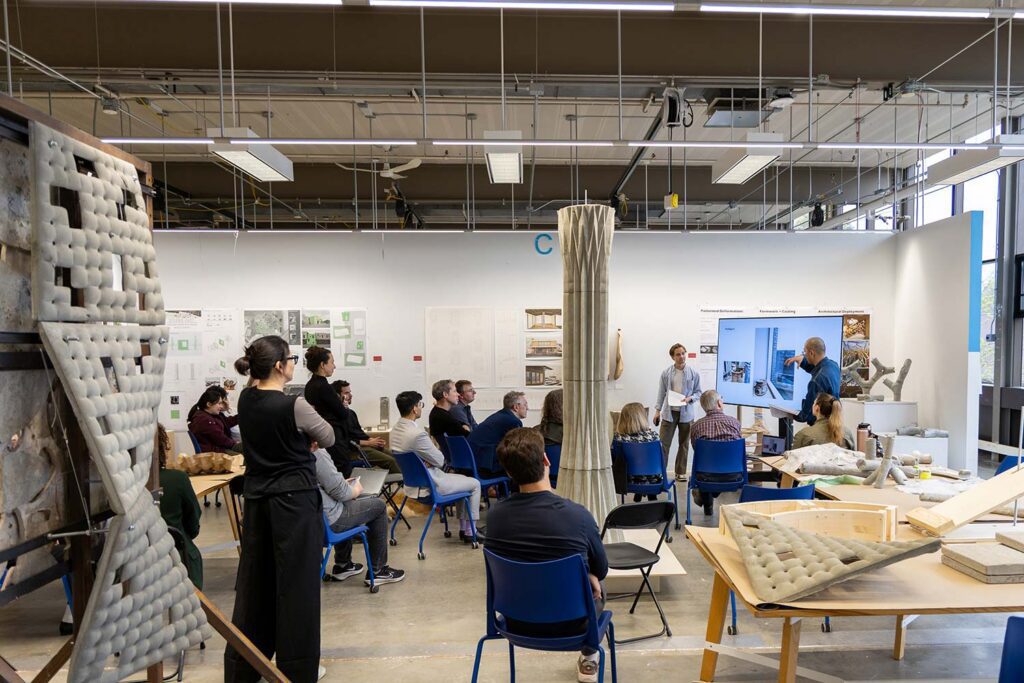
The team produced a dozen prototypes over the semester, along with rigorous analysis of how the positioning and number of folds, as well as the overall size of the piece, affected the hydrostatic pressure of fresh concrete. Computational design and the use of the Zünd cutting machine added accuracy and speed to manufacturing their formworks by scoring the folds, making the manual labor of folding much faster.
For their final project, they produced a column from four pieces, interlocked with plug-and-socket flanges. When the first attempt at pouring the base went sideways, Ng encouraged them to try again rather than spend time trying to correct it. Within one day, they were able to remake the formwork and recast, given their previous experience through trial and error. That extra effort paid off; the column stood strong in the middle of the review space, surrounded by their classmates’ experiments.
At the final review, Lam and Masternak were praised for both pushing boundaries and their thoughtful documentation. Among the admirers was Joseph Choma, professor of architecture and director of the Foldable Structures & Materials Lab at Florida Atlantic University, whose work had influenced the team.
Designing the Workflow
Beyond the studio, Ellis is eager to bring a fabrication perspective to her passion for computational and equitable design after graduation.
“It’s interesting to understand the process behind it, and it helps me with detail work, specifically understanding tolerances, offsets, the type of material that’s needed, and the durability of materials in the process of building,” she says. “I think that’s going to benefit all of us in the field.”
After all the iterations and hiccups along the way, Lam says he and his classmates have learned what it takes to not only design their individual projects but also the process of getting from start to finish.
“It’s the workflow we’re designing: everything that goes into making the thing that we’re making,” Lam says. “It’s not just a physical, tangible thing. It’s also this mindset and instruction handbook to pass on.”
— Eric Gallippo